



















































































The White House is weighing whether to withdraw support for a major crypto market structure bill after a public break with Coinbase, according to a report by Fox Business. The dispute centres on the Digital Asset Market Clarity Act, commonly known as the CLARITY Act, which the exchange argues would damage decentralised finance, limit innovation and favour traditional banking interests.
Administration anger after Coinbase move
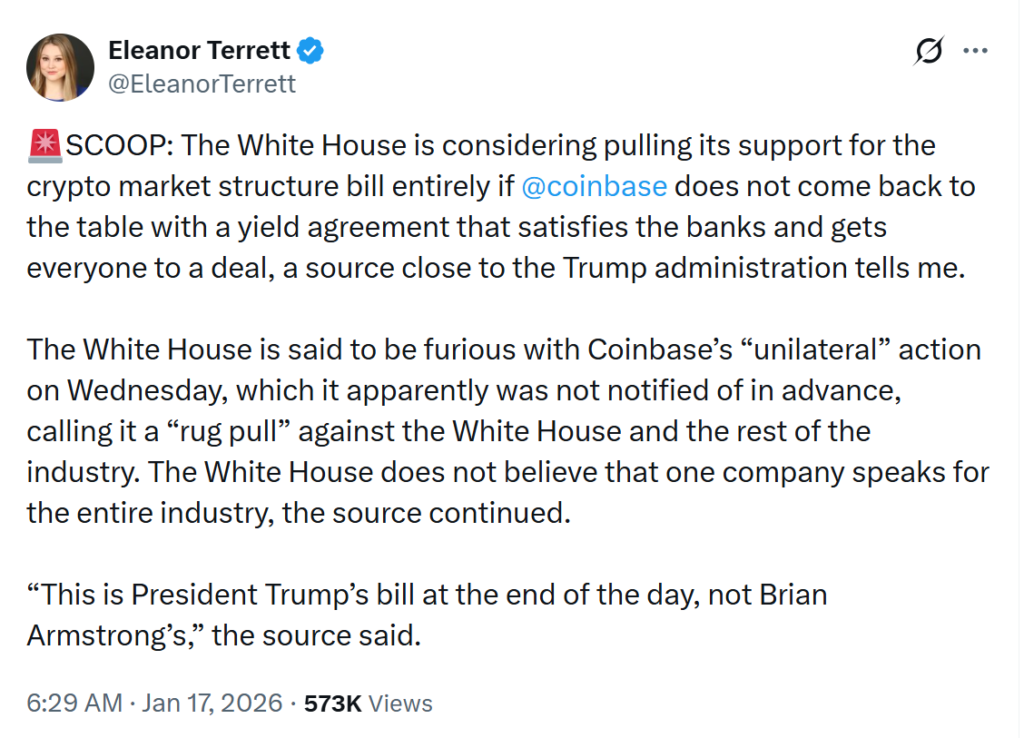
Fox Business reporter Eleanor Terrett said the White House was angered by Coinbase’s decision to pull its backing for the bill, citing a source close to the Trump administration. In a post on X, Terrett said officials viewed the decision as a sudden and unilateral move that caught them off guard.
The source described the decision as a rug pull against the White House and other industry participants involved in negotiations. According to the report, the administration may walk away from the bill entirely unless Coinbase returns to talks and agrees to compromise on provisions related to stablecoin rewards that are considered sensitive for banks.
The source added that the legislation ultimately belongs to President Donald Trump and not to any single company, highlighting frustration within the administration over what it sees as an attempt by one exchange to dictate policy.
Coinbase raises concerns over DeFi and privacy
Coinbase chief executive Brian Armstrong said on Wednesday that the company could not support the current draft of the CLARITY Act. He argued that the proposal, as written, would do more harm than good for the digital asset sector.
Armstrong said he would prefer no legislation to a flawed one, expressing hope that lawmakers and industry participants could reach a better version. Among his key objections was what he described as an effective ban on tokenised equities, alongside broad restrictions on decentralised finance protocols.
He also warned that the draft would expand government access to financial records, which he said could undermine user privacy. Armstrong further criticised the balance of regulatory power in the bill, arguing that it would weaken the Commodity Futures Trading Commission while concentrating greater authority with the Securities and Exchange Commission, an agency long criticised by the crypto industry for its enforcement focused approach.
Stablecoin rewards emerge as key flashpoint
Stablecoins have become a central point of contention in the debate. Armstrong said the bill risks eliminating rewards on stablecoins, reflecting wider industry fears that the measure is designed to shield banks from competition.
Banking groups have warned that allowing stablecoin users to earn yields of around five per cent could encourage consumers to move deposits out of traditional savings accounts. Crypto advocates counter that such yields are a product of innovation and efficiency rather than a threat to financial stability.
The White House source cited by Terrett suggested that resolving disagreements over stablecoin yield provisions could be crucial if the bill is to progress.
Industry reaction reveals deep divisions
Reaction from the wider crypto community has been mixed. Many users and industry figures supported Coinbase, accusing lawmakers and banks of prioritising incumbents over innovation. Nic Carter, cofounder of Coin Metrics, wrote on X that banks should stop exploiting consumers rather than seeking protection from competition.
Others criticised Coinbase for overplaying its hand and attempting to exert disproportionate influence over legislation that affects the entire sector. Some argued that while Coinbase is a major player, it does not represent the whole of crypto and should not be able to block a bill on its own.
As discussions continue, the standoff underscores the difficulty policymakers face in balancing innovation, consumer protection and the interests of traditional finance when shaping the future of digital asset regulation.