



















































































Decentralized finance platforms are quietly rethinking their reliance on Discord, once considered the default hub for crypto communities. What was meant to be an open space for discussion, support and collaboration is increasingly being seen as a risk, with phishing scams and impersonators overwhelming public servers. As a result, several major DeFi teams are moving toward ticket-based help desks, private live chats and email support systems that offer more control and user protection.
Public Discord Servers Become a Liability
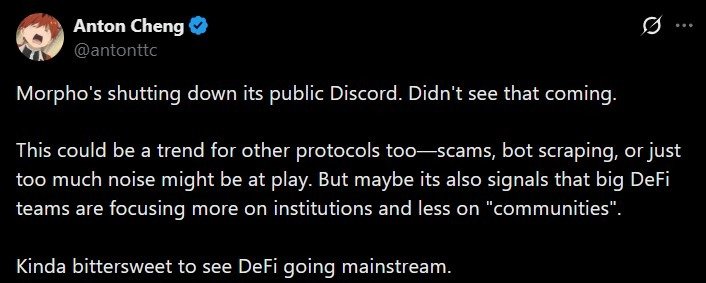
The shift gained wider attention this week after DeFi lending protocol Morpho announced that it had turned its public Discord server into read-only mode. Users seeking help are now redirected to alternative support channels. According to the team, the decision followed repeated incidents where users were targeted by scammers while asking questions in public chats.
Morpho co-founder Merlin Egalite said the move was not taken lightly. The protocol had invested heavily in moderation and safety tools, yet phishing attempts continued. Even with constant monitoring, scammers found ways to exploit the platform, often by impersonating administrators and sending direct messages to users looking for assistance.
The Morpho case is not isolated. Behind the scenes, several DeFi builders and data providers have been scaling back their Discord presence, arguing that the open nature of the platform makes it difficult to protect users from harm.
Why Scams Thrive on Discord
Builders point to Discord’s structure as a key problem. Public servers are easy to join, usernames can closely mimic official accounts, and direct messages are hard to police. Even when scammers are banned quickly, the damage is often already done.
DefiLlama’s pseudonymous founder 0xngmi said the platform has been gradually reducing its reliance on Discord in favor of live support chat and email ticketing. In a public post, he argued that Discord creates an environment where users are exposed to unnecessary risk.
According to 0xngmi, banning scammers does little to solve the core issue. Scammers often reach out to users directly, posing as support staff and exploiting confusion during high-stress situations such as stuck transactions or lost funds.
For protocols handling large sums of user capital, these risks are becoming harder to justify.
Shift Toward Structured Support Systems
In place of always-on chat rooms, many DeFi teams are experimenting with structured support tools. Morpho said it has been testing platforms like Intercom, which offer features such as ticket management, identity verification and automated responses.
Supporters of this approach argue that it prioritizes user safety over engagement metrics. Rather than encouraging constant conversation, these systems focus on resolving issues efficiently and reducing exposure to bad actors.
Builders say this model also helps internal teams. Moderating large Discord servers can be time-consuming and emotionally draining, especially when dealing with persistent scams and frustrated users.
Industry Voices Support the Move
Several industry figures have publicly backed the decision to step away from Discord. Richard Rodairos, a talent partner at venture firm Dragonfly, described public Discord servers as one of the lowest signal environments in crypto today.
Rodairos argued that clear documentation, asynchronous support and reliable communication channels would serve both users and builders better in the long run. He suggested that eliminating most crypto Discord servers could actually strengthen the industry.
Marc Zeller, founder of the Aavechan Initiative, echoed similar concerns. He said Discord is filled with scammers who prey on users asking basic questions, often pretending to be administrators. Zeller praised Morpho’s move and encouraged other major protocols, including Aave Labs, to consider a similar approach.
Duncan Cock Foster, co-founder of Nifty Gateway, shared that Discord moderation was the most difficult part of running his former company. He described it as a major strain on his mental health and called Morpho’s decision a smart and overdue step.
Critics Warn Against Losing Open Communities
Despite the growing support for moving away from Discord, not everyone agrees. Some community members argue that abandoning public servers risks weakening one of DeFi’s defining traits: open, peer-driven collaboration.
An X user known as Llamaonthebrink said the ability to drop into a project’s Discord, share experiences and follow development discussions is a core part of DeFi’s appeal. The user expressed concern that the trend could lead to more closed and less transparent ecosystems.
Others believe the problem lies not with Discord itself but with how it is managed. An X user posting as nft_dreww argued that scammers exist on all platforms and that well-run Discord servers with strong moderation and security practices can still thrive.
Another community member, Walter_Su11ivan, said stepping away from Discord reflects a lack of platform management skills rather than a fundamental flaw in the tool. He pointed out that many projects continue to maintain healthy and secure Discord communities.
A Broader Rethink of Crypto Communication
The debate highlights a broader question facing the crypto industry: how to balance openness with user protection. As DeFi matures and attracts less technical users, the tolerance for chaotic and risky communication channels is shrinking.
For now, there is no single standard approach. Some protocols are locking down their Discords, others are replacing them entirely, and a few are doubling down on better moderation. What is clear is that the role of Discord in DeFi is changing, and the era of unguarded public chat rooms may be coming to an end.