


















































































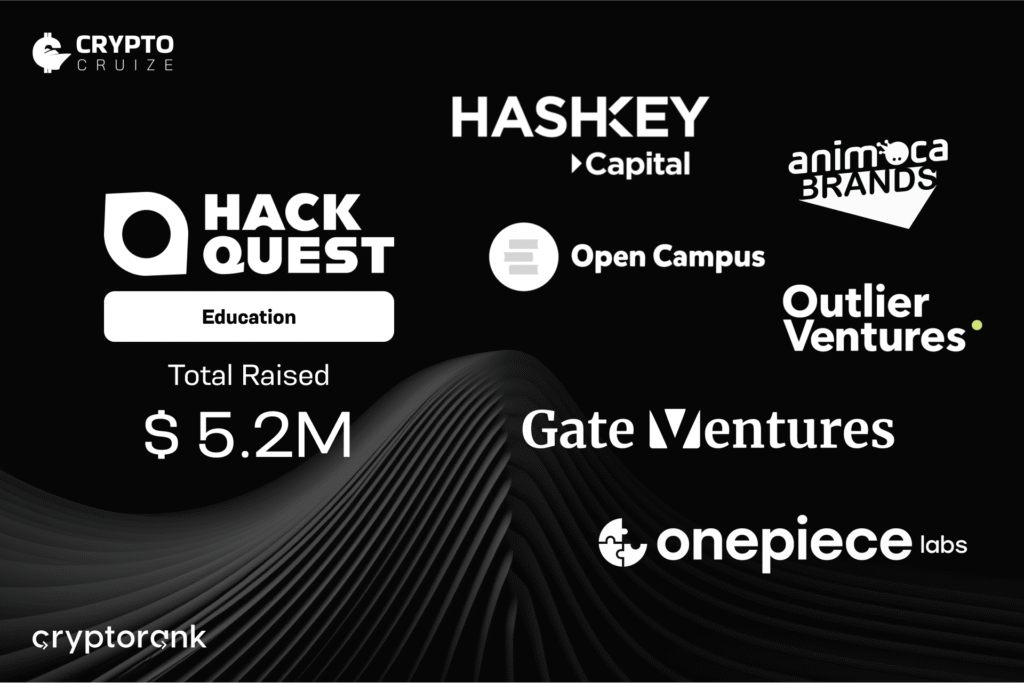
HackQuest, a developer-focused Web3 platform, has closed a $4.1 million Pre-A funding round led by Animoca Brands and Open Campus. The raise comes just months after the company’s $1.1 million pre-seed round in February 2024, bringing total funding to $5.2 million.
The funding round was led by prominent industry players Animoca Brands and Open Campus, with additional backing from Gate Ventures, HashKey Capital, Hash Global, Find Satoshi Labs (StepN), Outlier Ventures, Bytetrade Labs, and notable angel investors such as Scott Moore of Public Goods and YY of Signum Capital.
This new investment will be used to scale HackQuest’s operations and expand its educational and developer support programmes. The company’s goal is to create a long-term solution for Web3’s talent gap by providing developers with the tools, knowledge, and opportunities they need to thrive in decentralised ecosystems.
The Scale of the Problem
The numbers reveal a sharp disparity between the traditional Web2 and emerging Web3 developer landscapes. According to the Electric Capital 2024 Developer Report, there are around 28.7 million developers in the Web2 space but only 7,673 full-time developers in Web3.
This imbalance, a gap of over 4,000 times is slowing down blockchain innovation. Despite years of grant programmes and incentive schemes worth millions of dollars, retention has been poor. Many developers join projects temporarily for funding and leave once incentives run out, weakening the foundation of blockchain ecosystems.
HackQuest’s CEO, Kevin Li, highlighted this core issue:
“Developers are the leading indicator of value creation. Web2 thrives because developers stay and build. In Web3, we see the opposite, networks spend heavily on incentives but fail to retain talent.”
Cameron Wang, co-founder of HackQuest, added that many aspiring Web3 developers face a lack of clear entry points:
“Web3 doesn’t have a talent problem; it has an onboarding problem.”
A Full Developer Journey on One Platform
HackQuest’s approach is to offer an integrated, end-to-end developer ecosystem. The platform begins with structured educational courses, designed in collaboration with leading blockchain networks such as Mantle, Solana, Arbitrum, Linea, and BNB Chain. This ensures the learning material is not only theoretical but also directly applicable to current industry needs.
After completing courses, developers can take part in hackathons, workshops, and community events, both online and in-person. These practical experiences help participants apply their skills and build real-world projects.
A key innovation is HackQuest’s on-chain credentialing system. Every achievement from completing a course to participating in an event, is recorded on the blockchain as a verifiable credential. This creates a transparent, tamper-proof record of a developer’s skills and work, effectively serving as a blockchain-based CV.
Harry Zhang, co-founder of HackQuest, described this as a bridge between talent and opportunity:
“If you’re a blockchain startup or investor, you don’t have to guess whether a developer is qualified. You can see their verified journey.”
Beyond developer training, HackQuest connects participants to startup funding, accelerator programmes, and ecosystem grants, creating a seamless path from learning to launching ventures.
Rapid Growth and Global Reach
Since its 2024 launch, HackQuest has already shown strong market traction. The platform has generated $2 million in revenue, onboarded over 90,000 developers, and maintained a 30% month-on-month growth rate.
It has organised 219 in-person events and 112 hackathons, awarding more than $1.45 million in prizes. Its community now spans over 30 countries, with strong footholds in India, the United States, Greater China, Nigeria, and Singapore.
The company is actively expanding into other high-growth regions, including Indonesia, Turkey, Kenya, Brazil, Argentina, and Vietnam, working with local partners to build developer communities.
Building the Future of Web3 Talent
HackQuest is positioning itself as more than just a training platform, it aims to be the foundational infrastructure for Web3’s developer base. By integrating education, verifiable credentials, and direct links to funding and opportunities, it hopes to create a sustainable pipeline of skilled developers who will stay and build in the blockchain space.
The latest funding will allow HackQuest to enhance its educational offerings, grow its global presence, and refine its on-chain credentialing technology. In doing so, it aims to solve the retention challenge that has hindered Web3’s growth for years.
If successful, HackQuest could help close the developer gap, accelerate blockchain innovation, and ensure decentralised ecosystems have the talent they need to scale sustainably.