




















































































Bitcoin’s Current Price Lags Behind Energy Value Estimate
Bitcoin is significantly undervalued compared to its energy-derived “fair” price, according to new analysis by Capriole Investments. The company’s founder, Charles Edwards, suggests that Bitcoin should be trading at approximately $167,800, based on the cryptocurrency’s Energy Value metric. This implies that Bitcoin’s current price of around $116,000 is 31% below its energy-based valuation.
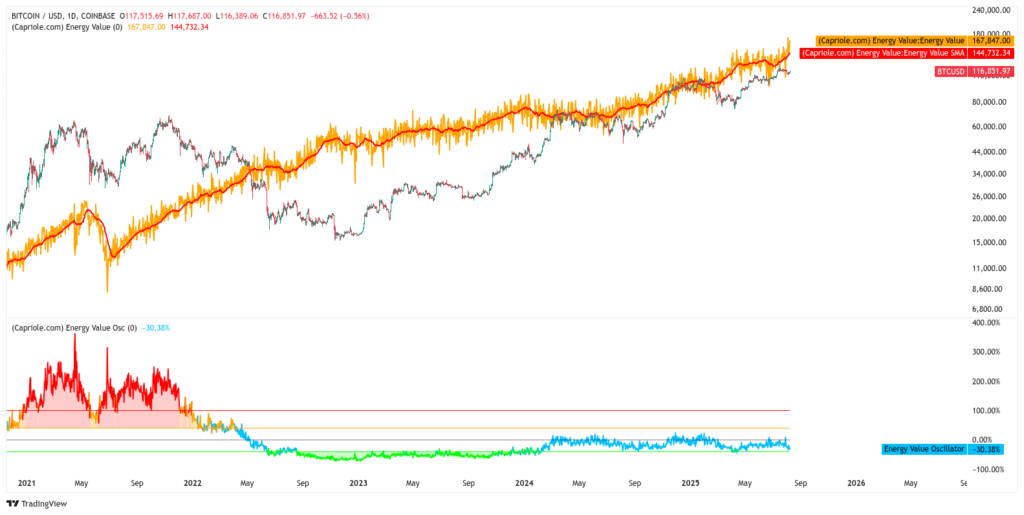
The Energy Value metric, first introduced by Capriole in 2019, calculates Bitcoin’s fair value using a formula that considers energy input from miners, the rate of supply growth, and a constant representing the dollar value of energy. This method posits that Bitcoin derives intrinsic value from the amount of energy expended to maintain its network.
Record Hashrates Suggest Strong Network Fundamentals
The estimate arrives as Bitcoin’s network reaches new levels of strength. Data from on-chain analytics platform Glassnode shows that the network’s hash rate, a measure of the total computational power used to secure the blockchain, recently hit a record 1.031 zettahashes per second (ZH/s).
According to Edwards, the Energy Value’s simple moving average now sits at $145,000, placing the actual price at a 31% discount. He noted that “we are trading at a deeper discount to value today at $116K than when Bitcoin was at $10K in September 2020.”
The current divergence between price and network fundamentals is being closely watched by analysts, many of whom expect Bitcoin to rise substantially in the coming months.
Energy Input Reflects Market Dynamics
The Energy Value theory suggests that market prices influence miner behaviour. Higher prices typically encourage miners to increase their energy input, either by expanding operations or improving efficiency through better technology. This creates a feedback loop where more committed energy increases Bitcoin’s Energy Value over the long term.
Capriole explains that “consistent energy input represents a balance between supply and demand,” and that speculative price surges not backed by increased energy input often result in price corrections. By contrast, when energy usage and hash power rise in tandem with price, the valuation tends to be more sustainable.
Bullish Signs from Miner-Focused Indicators
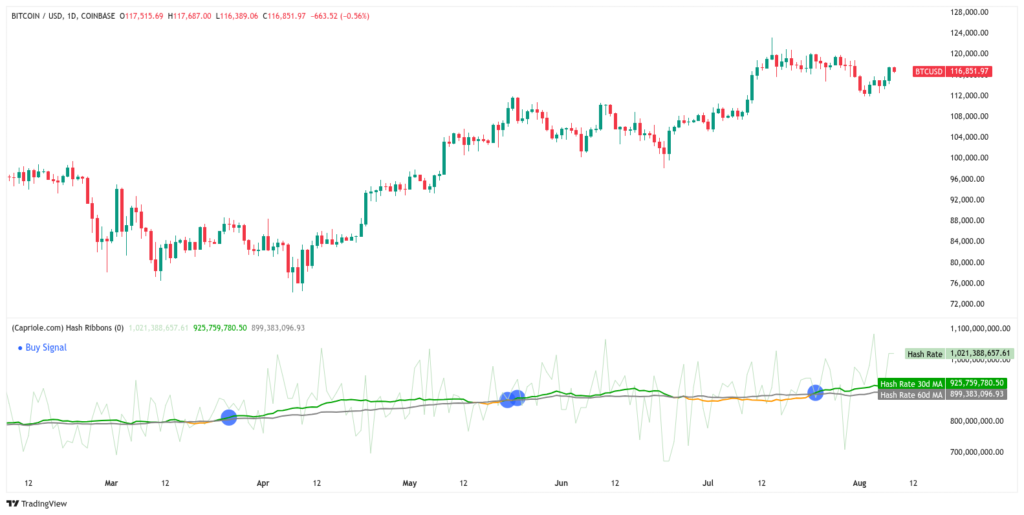
Bitcoin’s current network strength is also reflected in another important metric, the Hash Ribbons. This indicator, which tracks miner activity and signals potential buying opportunities, recently flashed a “buy signal” in late July. This further supports the view that miners remain confident about the future of the Bitcoin market.
The Energy Value analysis reinforces the idea that Bitcoin’s price still has considerable upside if it is to realign with fundamental metrics. With the hash rate continuing to surge, and market optimism growing, the outlook among miners and long-term investors remains broadly bullish.
A Limited Window for Price Correction
However, time may be running short for Bitcoin to catch up with its Energy Value rating during this market cycle. If energy input from miners decreases, the metric’s calculated fair price could also drop. Still, with fundamentals as strong as ever, some analysts believe that Bitcoin is well-positioned to climb further in the near term.
Charles Edwards concludes that “Bitcoin miners hold the key to a hyper-bullish BTC price,” and current network activity suggests their commitment remains firm.