




















































































Blockchain Investigator Highlights Links to Lazarus Group and Bybit Hack
Blockchain investigator ZachXBT has levelled serious accusations against Garden Finance, a self-proclaimed “fastest Bitcoin bridge,” alleging it played a central role in laundering stolen crypto funds. In a post on social media platform X dated June 21, ZachXBT claimed that over 80% of Garden’s recent fee revenue came from illicit transactions tied to notorious hacking groups, including North Korea’s Lazarus Group.
According to the investigator, these funds were primarily connected to the recent Bybit hack. He directly challenged the project’s claims of decentralisation, calling into question the credibility of its operations and fee transparency.
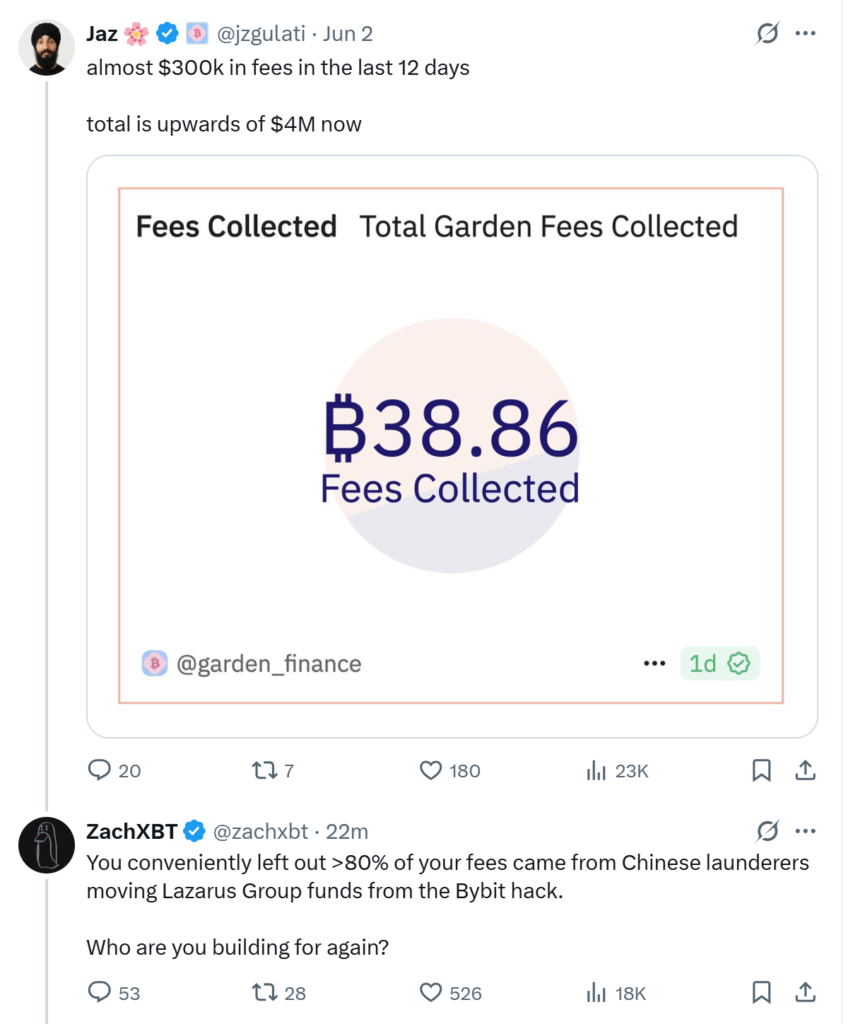
“You conveniently left out >80% of your fees came from Chinese launderers moving Lazarus Group funds from the Bybit hack,” ZachXBT wrote in response to a celebratory post by Garden Finance co-founder Jaz Gulati, who had earlier touted the platform’s growing popularity and income.
Liquidity Flow from Coinbase Raises Questions
ZachXBT further claimed that despite branding itself as decentralised and trustless, Garden Finance relied heavily on centralised liquidity sources. He alleged that a single actor repeatedly topped up cbBTC (bridged Bitcoin) liquidity from Coinbase, facilitating the laundering of hacked funds.
“Explain how it is ‘decentralised’ when I watched in real time for multiple days as a single entity kept topping up cbBTC liquidity from Coinbase,” ZachXBT argued, implying that the bridge’s operational model does not align with its stated decentralised ethos.
Founder Denies Claims, Cites Misinformation
In response to the allegations, Garden Finance’s founder Jaz Gulati denied any wrongdoing. He stated that a significant portion of their fees, around 30 BTC, was earned before the Bybit hack occurred, suggesting that the platform’s growth and success were not primarily driven by illicit activity.
Gulati dismissed ZachXBT’s criticisms as “misinformation”, rejecting the claim that Garden Finance operates under a “fake decentralised” model.
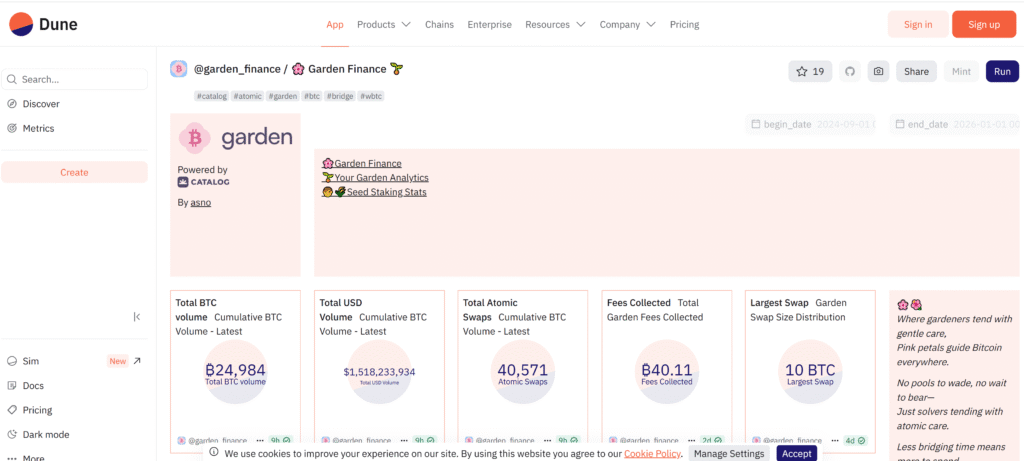
Garden Finance enables cross-chain swaps in under 30 seconds and claims to eliminate custody risk. According to its Dune Analytics dashboard, the project has processed more than 24,984 BTC (roughly $1.5 billion) through over 40,000 atomic swaps. To date, it has collected 40.11 BTC in total fees, with the largest individual swap reaching 10 BTC.
Related Case: Crypto Founder Arrested for $530M Laundering Scheme
In a related development, Iurii Gugnin, founder of crypto payments firm Evita Pay, was arrested last week in New York on federal charges involving a separate large-scale money laundering operation. Gugnin faces 22 criminal counts, including wire fraud, money laundering, and operating an unlicensed money transmission business.
The U.S. Department of Justice alleges that from June 2023 to January 2025, Gugnin facilitated stablecoin transactions for clients associated with sanctioned Russian banks, including Sberbank and VTB. These transactions allegedly enabled access to sensitive U.S. technologies, violating international sanctions and financial regulations.
If convicted, Gugnin could face a life sentence.
Industry Scrutiny Intensifies
Both cases highlight growing scrutiny within the crypto industry as regulators and independent investigators crack down on decentralised finance (DeFi) platforms and digital payment systems used to circumvent global regulations. As bridges like Garden Finance continue to attract high transaction volumes, questions surrounding transparency, compliance, and true decentralisation remain under the spotlight.