





















































































The US National Credit Union Administration has taken its first formal step toward regulating payment stablecoins within the credit union system, proposing a federal licensing pathway for stablecoin issuers that operate through credit union subsidiaries. The move follows the passage of the Guiding and Establishing National Innovation for US Stablecoins Act and signals how credit unions may eventually participate in the stablecoin market under federal oversight.
The proposal, released as a notice of proposed rulemaking, focuses narrowly on licensing, supervision, and investment limits. Broader operational standards tied to reserves, capital, and risk management are expected in a later rulemaking.
Licensing path under the GENIUS Act
Under the proposed framework, any payment stablecoin issuer that is a subsidiary of a federally insured credit union would be required to obtain a National Credit Union Administration permitted payment stablecoin issuer license before issuing tokens. Without this license, issuance would not be allowed.
The proposal also places clear limits on the activities of credit unions themselves. Federally insured credit unions would be barred from investing in or lending to payment stablecoin issuers unless those issuers hold the NCUA license. This effectively makes the license a gatekeeper not only for issuance but also for access to credit union capital and partnerships.
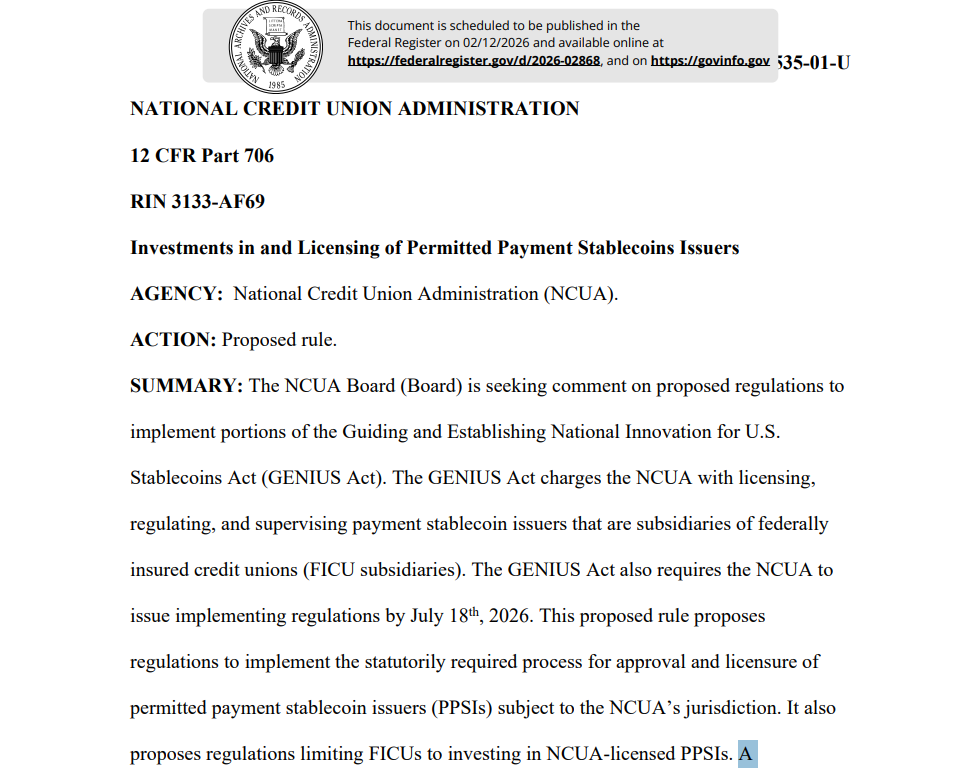
The NCUA is using this rulemaking to define how licensing would work in practice, including the application process and supervisory structure. It does not yet set detailed financial or operational requirements for stablecoin issuers.
Credit unions and the scope of oversight
The NCUA oversees more than 4,000 federally insured credit unions across the United States. As of mid 2025, these institutions serve about 144 million members and collectively hold roughly $2.38 trillion in assets.
The proposal reflects a core design choice in the GENIUS Act. Insured depository institutions, including credit unions, are not allowed to issue payment stablecoins directly. Instead, they must operate through separate legal entities that are federally supervised and meet uniform standards.
For credit unions, this typically means using credit union service organizations or other qualifying subsidiaries that fall under the NCUA’s jurisdiction. These subsidiaries would be the entities eligible to apply for the payment stablecoin issuer license.
Public blockchain neutrality and approval timelines
Two elements of the proposal stand out for the broader digital asset market.
First, the NCUA would be explicitly barred from rejecting an application solely because a stablecoin is issued on an open, public, or decentralized network. This language makes clear that issuing on a public blockchain cannot, by itself, be grounds for denial. While the agency could still evaluate risks tied to technology or governance, it would not be able to dismiss public chain issuance outright.
Second, the proposal introduces a firm decision timeline. Once an application is deemed substantially complete, the NCUA would have 120 days to approve or deny it. If the agency fails to act within that window, the application would be automatically deemed approved.
This default approval mechanism mirrors provisions in the GENIUS Act and is designed to prevent applications from being stalled indefinitely. For potential issuers, it adds a measure of predictability to the regulatory process.
What comes next for stablecoin rules
The current proposal is limited in scope. It does not yet address the core prudential standards that payment stablecoin issuers will ultimately have to meet. According to the NCUA, a separate and forthcoming proposal will implement the GENIUS Act’s requirements related to reserves, capital, liquidity, illicit finance controls, and information technology risk management.
For now, the rulemaking is about setting up the licensing and oversight architecture. Any future rollout of stablecoin products to credit union members would still depend on additional approvals and compliance with the later standards.
The NCUA has opened a public comment period of 60 days from publication in the Federal Register. During this window, industry participants, consumer groups, and other stakeholders can weigh in before the agency finalizes or revises the licensing regime.
The agency said it reached out for additional comments but had not received a response by the time the proposal was published.