



















































































The founder of Uniswap has raised fresh concerns over fraudulent crypto advertisements after an investor reportedly lost a mid six figure portfolio to a fake website posing as the popular decentralized exchange.
Hayden Adams, who launched the decentralized trading platform Uniswap, said scam advertisements impersonating the platform continue to resurface despite repeated complaints. His remarks followed a widely shared account from a victim who claimed his entire crypto wallet was drained after interacting with what appeared to be a legitimate search result.
The incident comes at a time when crypto related scams are once again surging, with January recording the highest monthly losses in nearly a year.
Fake Ads Masquerading as Uniswap
According to Adams, scammers are purchasing advertising space on major search engines using keywords such as “Uniswap.” When users search for the exchange, the top sponsored result can appear authentic at first glance.
Victims who click on these ads are redirected to lookalike websites that closely mimic the real Uniswap interface. Once on the site, users are prompted to connect their wallets and approve transactions. In doing so, they unknowingly grant attackers access to their funds.
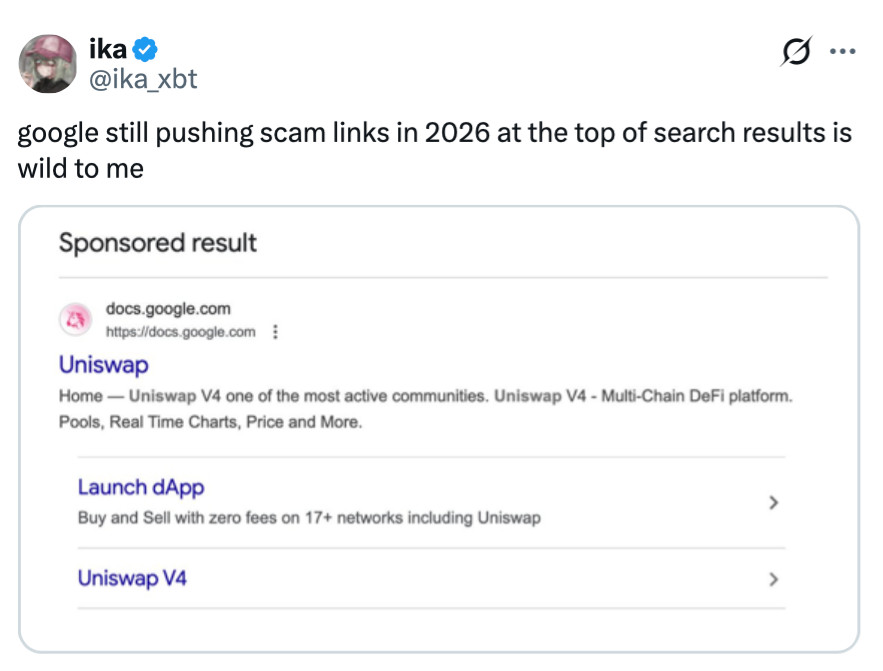
“Scam ads keep returning despite years of reporting,” Adams wrote on X. He added that similar issues had previously surfaced during delays in app store approvals, when fake Uniswap apps circulated online.
The problem highlights an ongoing challenge in the crypto space, where phishing websites often replicate official branding with alarming accuracy.
A Costly Lesson for One Investor
The warning gained traction after an X user known as Ika shared a detailed account titled “I lost everything, what’s next?” In the post, he said his crypto wallet, valued in the mid six figure range, had been completely drained.
Ika described himself as disciplined and cautious over the past two years, splitting his time between exploring opportunities in Web3 and building his holdings. Despite his vigilance, he fell victim to what he later realized was a fraudulent top search result.
He posted a screenshot showing a sponsored Google link that appeared to lead to Uniswap but was in fact a malicious site.
Reflecting on the incident, Ika wrote that being drained was not simply bad luck but the result of “a long chain of bad decisions.” His post quickly circulated within the crypto community, sparking renewed discussion about search engine advertising policies and user safety.
A Recurring Problem for Uniswap
This is not the first time scammers have exploited Uniswap’s brand.
In October 2024, reports surfaced that fraudsters had created nearly identical versions of the Uniswap website. The fake versions were designed with subtle but telling differences. For example, a “connect” button replaced the legitimate “get started” option, and a “bridge” button appeared where users would normally find documentation links.
These changes were enough to trick users into signing malicious transactions. Because decentralized platforms like Uniswap rely on wallet connections rather than traditional logins, approving a single transaction can expose an entire account.
The open and permissionless nature of decentralized finance has long been both its strength and its vulnerability. While users maintain full control over their funds, they also bear full responsibility for security.
Crypto Losses Surge in January
The Uniswap related case unfolded against a broader spike in crypto related theft.
Last month, the total value of cryptocurrency stolen through exploits and scams reached approximately 370.3 million dollars, marking the highest monthly figure in 11 months. The amount represented a nearly fourfold increase compared with January 2025.
Blockchain security firm CertiK reported 40 exploit and scam incidents during the month. A significant portion of the total losses stemmed from a single case in which one victim reportedly lost around 284 million dollars due to a social engineering attack.
These figures suggest that while market sentiment may fluctuate, scammers remain persistent and adaptable.
Ongoing Battle Against Fraud
Adams’ comments reflect a broader frustration within the industry. Crypto founders and developers have repeatedly called on search engines and app stores to more aggressively police fraudulent advertisements and impersonation attempts.
At the same time, security experts continue to urge users to double check website URLs, avoid clicking on sponsored links for financial services, and rely on bookmarked official pages when accessing wallets or exchanges.
For many victims, however, the damage is already done. As Ika’s story demonstrates, even experienced participants can be caught off guard when a single click leads to irreversible consequences.