



















































































Ankara Proposes Tougher Crypto Regulations to Combat Illicit Finance
Turkey’s Ministry of Treasury and Finance is set to implement a series of stringent new rules for the cryptocurrency sector, aimed at curbing money laundering and financial crime. The proposals, disclosed by state-run Anadolu Agency (AA), include mandatory source and purpose data collection for crypto transactions, transfer limits for stablecoins, and withdrawal delays.
The move represents one of the country’s most comprehensive efforts to bring its crypto regulatory framework in line with international standards such as the EU’s Markets in Crypto-Assets (MiCA) regulation.
Mandatory Transaction Descriptions and Withdrawal Delays
According to the proposed rules, all cryptocurrency platforms operating in Turkey will be required to collect detailed information about the origin and purpose of every transaction conducted on their systems. Each transfer must include a transaction description of at least 20 characters, as per the draft legislation.
In cases where the Financial Action Task Force’s (FATF) Travel Rule does not apply, platforms will have to enforce holding periods before users can withdraw funds. These include a 48-hour delay for most transactions and a 72-hour delay for the first withdrawal from any newly created account.
This delay is intended to allow platforms additional time to assess the legitimacy of transfers and flag potentially suspicious activity.
Strict Limits on Stablecoin Transfers
The Finance Ministry is also looking to impose new limits on daily and monthly stablecoin transfers, aimed at slowing the rapid outflow of funds linked to illegal activities such as fraud and unlawful gambling.
Under the new rules, users will be allowed to transfer a maximum of $3,000 per day and $50,000 per month in stablecoins. However, platforms that comply fully with Travel Rule obligations, including collection of complete sender and recipient identity details, will be eligible to apply double these limits for verified users.
Transfers related to market operations such as liquidity provision, market making, or arbitrage will be exempt from these restrictions, provided platforms can verify the origin of the funds and monitor such activities accordingly.
Sanctions and Licensing Risk for Non-Compliance
Treasury and Finance Minister Mehmet Şimşek emphasised that the purpose of these regulations is not to disrupt legitimate crypto trading, but to restrict criminal exploitation of the digital asset space.
“The space for legitimate crypto asset activities will be preserved,” Şimşek told Anadolu Agency, adding that platforms that fail to comply could face serious consequences. These include administrative fines, legal actions, and even the denial or cancellation of operational licences.
The government aims to balance innovation and investor access with strong oversight to safeguard the financial system.
Turkey Aligns with Global Crypto Standards
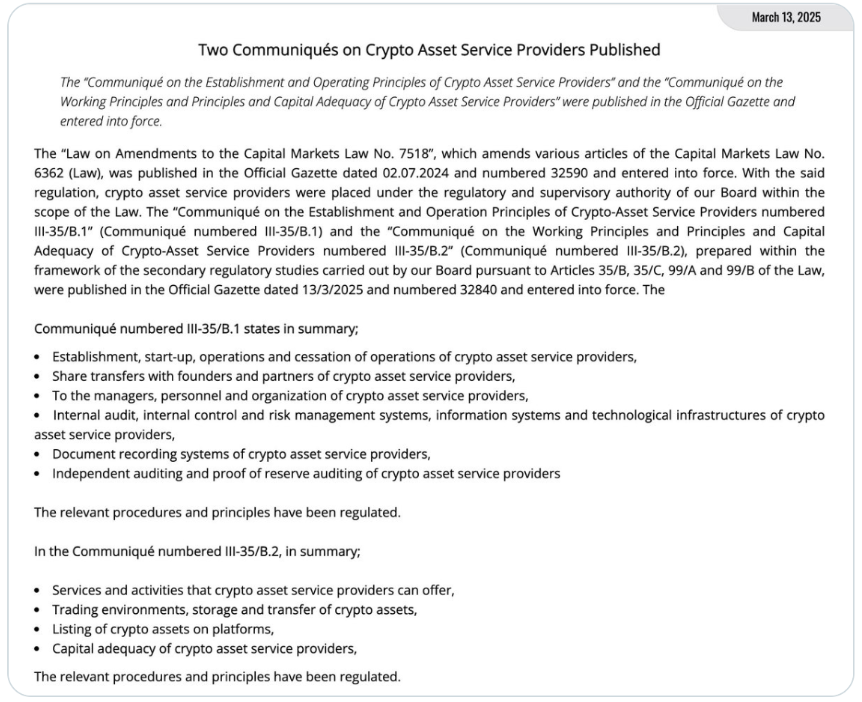
This latest initiative is part of a broader regulatory overhaul to harmonise Turkey’s crypto governance with international frameworks. In March 2025, the Capital Markets Board (CMB) introduced a licensing system and operational guidelines for crypto asset service providers (CASPs), placing the sector under full regulatory control.
The framework mandates strict eligibility requirements for crypto firms, including conditions for executive experience, shareholder structures, and minimum capital thresholds. Crypto exchanges must hold a minimum of $4.1 million in capital, while crypto custodians are required to maintain at least $13.7 million.
These regulations mirror standards set by global bodies such as the EU, FATF, and the International Organization of Securities Commissions (IOSCO), reinforcing Turkey’s intention to build a safe and transparent digital asset ecosystem.
Conclusion
Turkey’s proactive approach toward regulating the cryptocurrency industry marks a pivotal shift in the country’s financial oversight strategy. By enforcing transaction transparency, limiting high-risk fund flows, and aligning with international standards, Ankara is positioning itself as a serious player in global crypto governance.
As the proposed regulations move toward implementation, stakeholders in Turkey’s growing digital asset market will need to adapt swiftly or risk falling foul of a rapidly maturing compliance environment.