



















































































Sui Network has endured a turbulent Q1 2025, with its circulating market capitalization plummeting by 40.3% to $7.2 billion. This steep drop, significantly sharper than the overall crypto market’s 18.2% decline, has raised questions about the token’s short-term sustainability. However, a closer look at the ecosystem reveals signs of resilience, especially in DeFi growth and infrastructure development.
Market Cap Crash & Unlock-Driven Pressure
According to Messari’s latest quarterly report, the primary catalyst for Sui’s decline was the large-scale token unlocks between January and March. A total of 242.5 million tokens were released into circulation, distributed among early contributors, investors, and community reserves. Although this represented just 2.42% of the total supply, its market valuation stood at a hefty $549.9 million, enough to trigger notable sell pressure and impact investor sentiment.
Despite this, Sui’s relative positioning improved. It climbed two places to become the 13th largest cryptocurrency by market capitalization, suggesting competitors fared even worse during the downturn.
Fee Generation Drops but Cost Efficiency Holds
Sui’s on-chain activity mirrored the declining token price. The network generated $3.6 million in transaction fees during Q1 2025, a 33.3% drop from the previous quarter. In terms of SUI-denominated fees, the fall was sharper at 44.4%, driven by reduced user engagement and falling asset value.
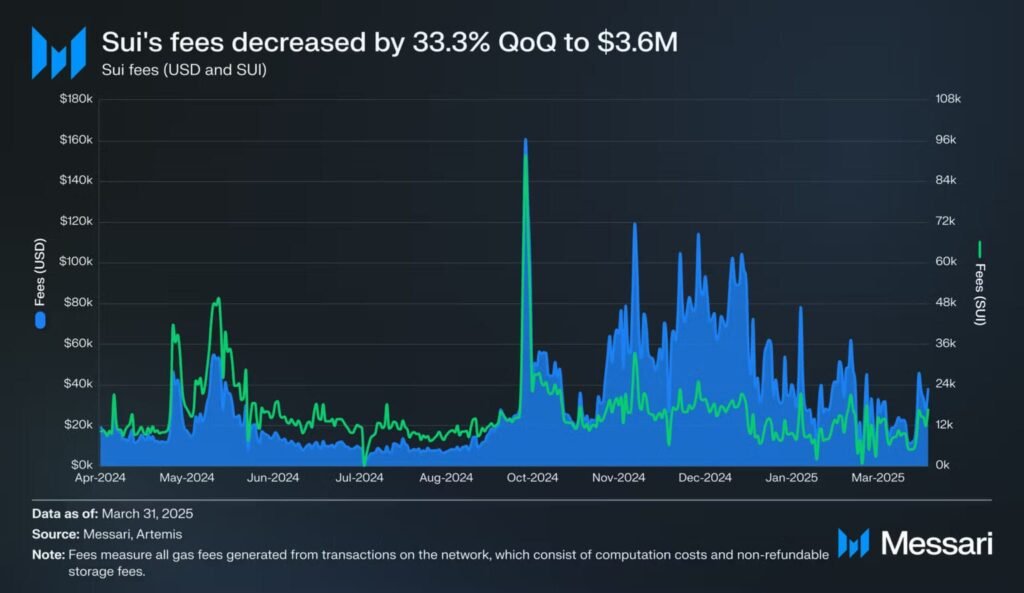
Yet, Sui’s low-cost transaction model remained intact. With an average fee of just $0.0087 per transaction, the network continued to support frictionless usage. Notably, over 23% of transactions were sponsored, reinforcing accessibility and developer adoption even in a bearish environment.
Staking, Inflation, and Real Yield Concerns
Sui’s staking metrics revealed a mixed picture. While 77.3% of the eligible supply remained staked by the end of Q1, inflationary pressure due to unlocks weighed heavily on returns. The integration of liquid staking for locked tokens further complicated the picture, driving the annualised real yield into negative territory at -0.14%.
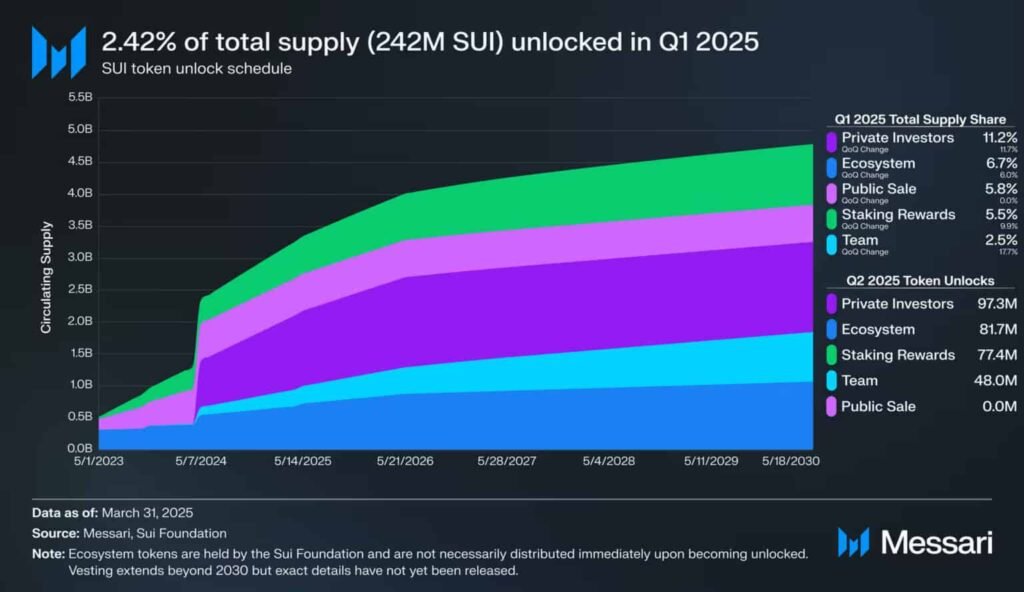
This shift indicates that while users may still be incentivised to stake, inflation and lower token value are eroding net returns, a trend worth watching in future quarters.
DeFi and DEX Ecosystem Show Resilience
Sui’s decentralised finance (DeFi) ecosystem showed signs of stability despite overall value erosion. Suilend retained its top position with $362.1 million in total value locked (TVL), accounting for a 29.3% share, even after a 25.6% drop. Its key innovation, STEAMM, a superfluid AMM that allows simultaneous LP deployment across lending and swaps, highlighted the network’s focus on capital efficiency.
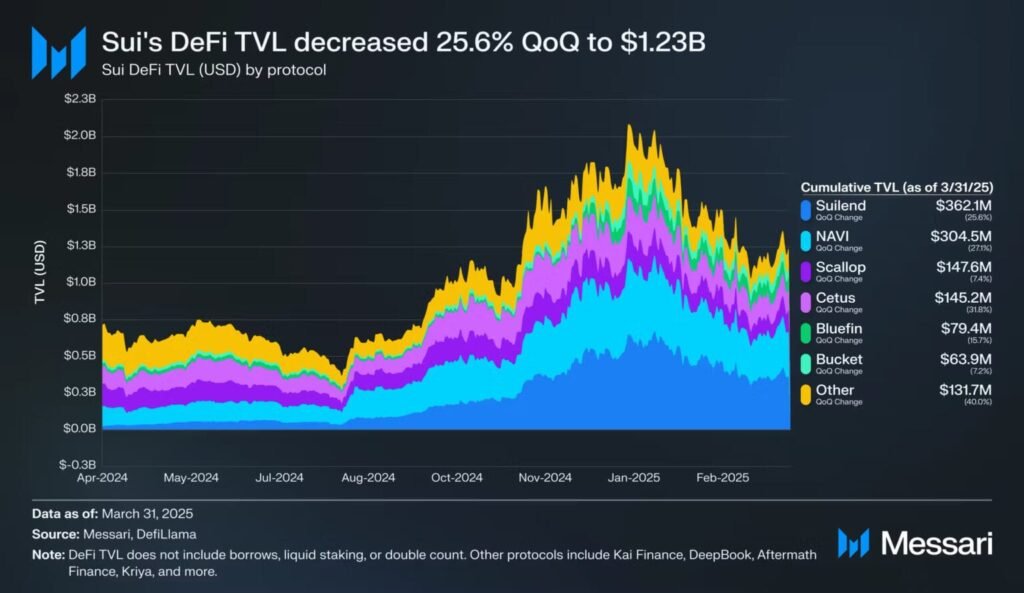
NAVI followed closely with $304.5 million in TVL and a 24.7% market share. It rebranded its NAVI.ag aggregator to Astros, expanding swap capabilities via Mayan Finance. Scallop, with $147.6 million in TVL, also made notable progress, crossing $300 million in swap volume and expanding multicurrency support. Its native SCA token secured listings on major exchanges like BTSE and Coinstore.
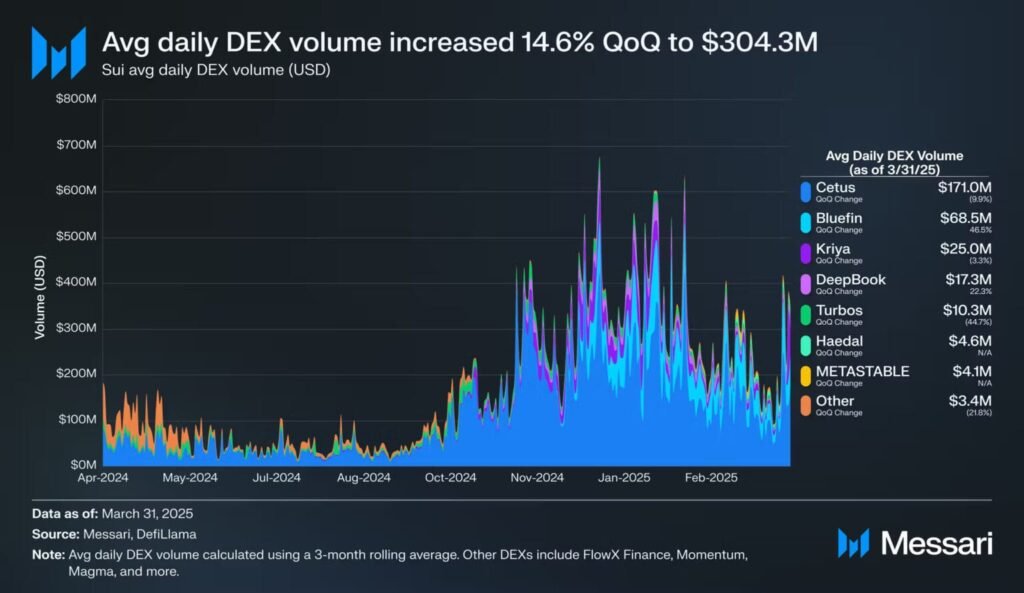
Meanwhile, Sui’s decentralised exchanges (DEXs) hit a new benchmark. Average daily volumes rose 14.6% to $304.3 million. Cetus led the pack with $171 million, followed by Bluefin with $68.5 million. Additional contributors like Kriya, DeepBook, and Turbos continued to benefit from the network’s high throughput and improving trading infrastructure.