


















































































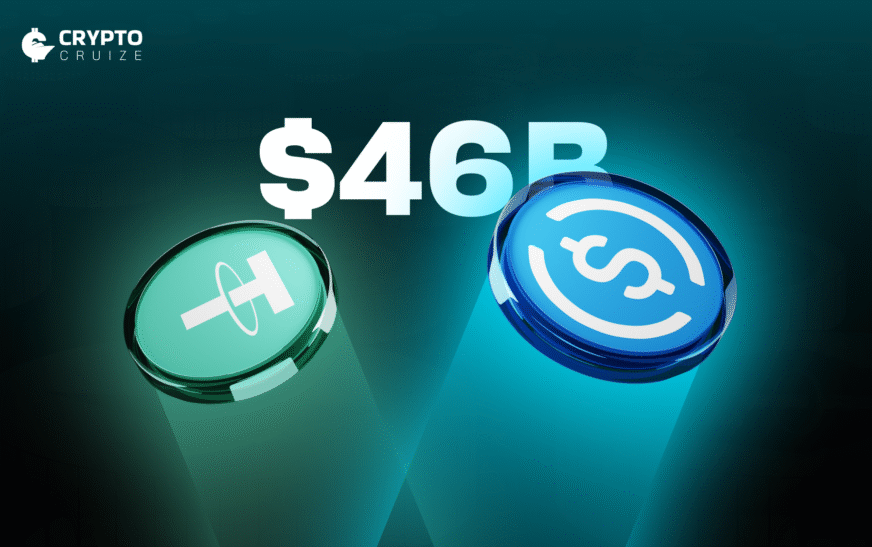
The stablecoin sector has posted one of its strongest quarters to date, with net inflows soaring to $45.6 billion in Q3, marking a 324% increase from the $10.8 billion recorded in the second quarter. The sharp rise highlights growing demand for dollar-pegged assets as traders, institutions and decentralised finance (DeFi) protocols increasingly rely on stablecoins for liquidity and settlement.
According to data from RWA.xyz, Tether’s USDT dominated the quarter with $19.6 billion in net inflows, followed by Circle’s USDC with $12.3 billion. New entrant Ethena’s synthetic stablecoin USDe also made a significant impact, securing $9 billion in inflows over the three-month period.
The surge underlines not only the dominance of USDT and USDC, which together account for more than 80% of the market, but also the growing appetite for alternative models such as algorithmic stablecoins.
Key Players: Tether, USDC and Ethena USDe
Tether’s USDT continued to cement its position as the market leader, recording the largest inflows in both Q2 and Q3. After minting $9.2 billion in Q2, the company more than doubled its momentum in Q3, reaching $19.6 billion. With 59% market share, USDT remains the cornerstone of stablecoin liquidity across both centralised and decentralised exchanges.
Circle’s USDC staged a dramatic comeback this quarter. Having added only $500 million in Q2, the stablecoin expanded to $12.3 billion in net issuance in Q3, signalling renewed confidence in the asset after a period of market scepticism earlier this year.

Meanwhile, Ethena’s USDe became the standout newcomer. The synthetic stablecoin posted $9 billion in inflows, up from just $200 million in the second quarter. Its rapid rise underscores growing investor appetite for algorithmic dollar-pegged assets, despite lingering concerns around stability in this category.
Other projects also contributed meaningfully to the quarter’s inflows. PayPal’s PYUSD added $1.4 billion, while MakerDAO’s USDS captured $1.3 billion. Ripple’s newly launched RLUSD and Ethena’s second product, USDtb, reported steady early growth, suggesting expanding competition within the stablecoin arena.
Ethereum Dominates the Stablecoin Landscape
From a network perspective, Ethereum continues to lead as the dominant chain for stablecoins, hosting a circulating supply of $171 billion. Tron followed as the second-largest with $76 billion, while emerging ecosystems such as Solana, Arbitrum and BNB Chain collectively held around $29.7 billion.
The dominance of Ethereum highlights its established role as the backbone of DeFi activity, where stablecoins remain central for lending, trading and yield generation. However, Tron’s growing base underscores its appeal for low-cost transfers, particularly in retail and remittance use cases.
Despite the surge in inflows, RWA.xyz data noted that monthly active addresses fell 22.6% to 26 million, while transfer volume declined 11% to $3.17 trillion. This suggests that while demand for stablecoins as an asset class is accelerating, transactional activity has temporarily slowed.
Market Outlook: $290B and Rising
The broader stablecoin market cap has now climbed to around $290 billion, according to DefiLlama, reflecting the impact of the quarter’s record inflows. Tether leads with nearly 59% market dominance, while USDC follows at roughly 25%. Ethena’s USDe, in less than a year, has already captured close to 5% of the market.

The rapid rise in inflows suggests stablecoins are becoming increasingly vital to global crypto liquidity. Yet, regulatory agencies continue to warn of systemic risks, with Moody’s recently highlighting the danger of “cryptoisation” in emerging markets due to fragmented oversight.
Still, Q3’s surge points to robust and growing confidence in stablecoins as the de facto digital dollar of the crypto ecosystem. As competition heats up, the balance of power between established players like USDT and USDC and newer entrants such as USDe could reshape the sector in the quarters ahead.