

















































































Polkadot has introduced a hard cap on the supply of its native token DOT after its decentralised autonomous organisation (DAO) approved a landmark referendum. The decision sets the maximum supply at 2.1 billion tokens, signalling a significant shift in the project’s long-term economic model.
From Unlimited Inflation to Controlled Supply
Previously, Polkadot operated on an inflationary model that allowed the indefinite issuance of new tokens. Around 120 million DOT were minted each year, and without intervention, the total supply was projected to exceed 3.4 billion by 2040. The new system curbs this trajectory, introducing a gradual issuance reduction every two years.
The project confirmed that the reduction will take place on Pi Day, 14 March. At present, Polkadot’s supply stands at approximately 1.5 billion tokens. A chart shared by the network highlights how the new model will diverge from the earlier inflation-driven growth.
Institutional Focus Through Capital Markets Division
The decision to reshape tokenomics coincides with Polkadot’s move to attract traditional finance. On 19 August, the project launched the Polkadot Capital Group, a division tasked with connecting Wall Street institutions to its blockchain infrastructure.
The group aims to encourage institutional involvement across asset management, banking, venture capital, exchanges and over-the-counter trading. It will also showcase use cases in decentralised finance, staking and real-world asset tokenisation, positioning Polkadot as a bridge between crypto and conventional markets.
Immediate Market Reaction
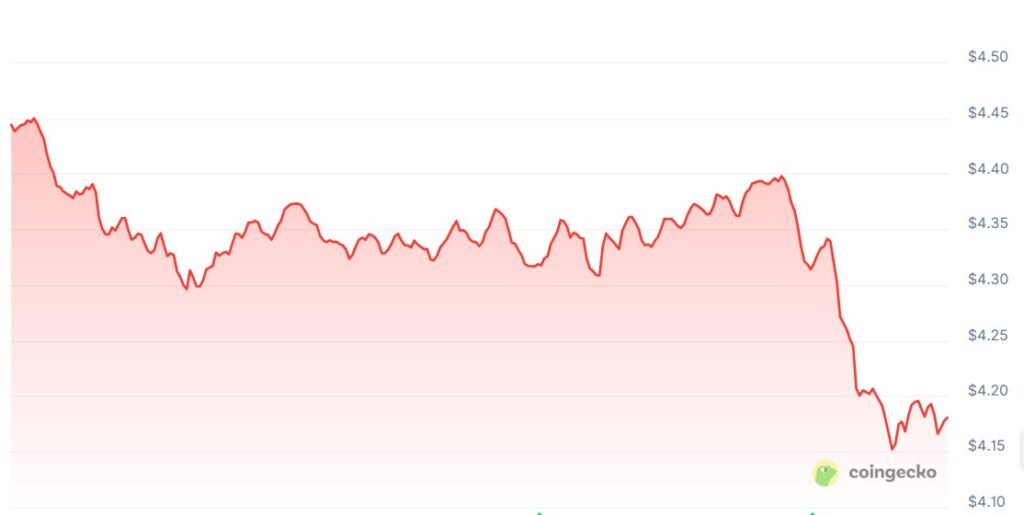
Despite the potential long-term benefits, the market response was less than enthusiastic. Following the announcement, DOT’s price slipped nearly five percent, falling from $4.35 to $4.15. At the time of reporting, it was trading around $4.13.
The short-term decline contrasts with expectations that the capped supply will eventually create scarcity and curb inflationary pressure. Supporters argue that the move should improve predictability for investors and provide stronger foundations for long-term growth.
A Strategic Pivot for the Future
While the Web3 Foundation, the team behind Polkadot, has not issued further comment, analysts suggest that the DAO’s decision marks one of the most significant tokenomics pivots in the project’s history. With a capped supply and a focus on institutional adoption, Polkadot appears to be positioning itself for greater relevance in both decentralised finance and mainstream capital markets.