






















































































Second veto deepens regulatory uncertainty
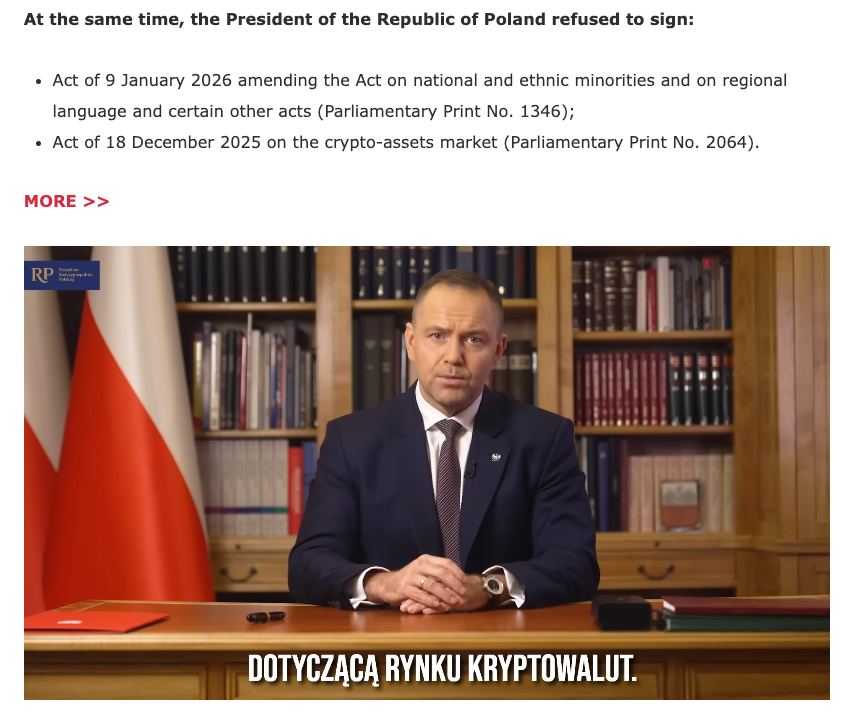
Poland’s efforts to align its crypto market with European Union rules have hit another roadblock after President Karol Nawrocki vetoed a second bill aimed at implementing the EU’s Markets in Crypto-Assets Regulation. The decision leaves domestic crypto companies without a clear licensing framework as a key EU transition deadline draws closer.
The president declined to sign Bill 2064 last week, according to his office, repeating a move he made in December when he vetoed a similar proposal. Both bills were intended to bring Polish law in line with Markets in Crypto-Assets Regulation, better known as MiCA, which sets out uniform rules for crypto asset service providers across the European Union.
Regulator warns of July 2026 deadline
The veto came shortly after the Polish Financial Supervision Authority warned that Poland has yet to appoint a competent authority to supervise the crypto market under MiCA. Without such an authority, local firms cannot formally apply for licenses required to continue operating once the transition period ends on July 1, 2026.
The regulator’s warning underlined the growing gap between Poland and other EU member states that have already established supervisory structures and begun issuing MiCA licenses. For Polish platforms, the lack of a domestic pathway is forcing difficult decisions about their future.
Industry players look abroad for solutions
Some companies say they have been preparing for this scenario for months. Kanga Exchange co-CEO Sławek Zawadzki said the firm had anticipated delays in Polish legislation and developed alternative plans.
According to Zawadzki, Kanga considered early on that the MiCA implementing law might not take effect in time. As a result, the exchange explored licensing options in other jurisdictions to ensure continuity of its business.
A similar strategy has already been adopted by Zonda Crypto, which was founded in Poland but is now registered in Estonia. CEO Przemysław Kral said the exchange chose to operate abroad years ago due to regulatory uncertainty at home and plans to passport its MiCA license back into the Polish market.
Political divisions and overregulation concerns
President Nawrocki justified his decision by arguing that Bill 2064 was practically identical to the earlier proposal he rejected. Both bills faced criticism from crypto supporters and free market advocates who warned that the rules would amount to overregulation and hurt innovation.
Polish politician Tomasz Mentzen was among the vocal critics, describing the legislation as excessively restrictive for a fast developing sector. Nawrocki echoed similar concerns, saying he would not approve a law he believes is harmful simply because it was passed again by a parliamentary majority. In his view, Poland should focus on attracting innovation rather than driving it away.
The veto highlights ongoing divisions within Poland’s government over how strictly the crypto sector should be regulated and how closely national rules should mirror EU frameworks.
Foreign firms gain advantage as locals wait
While some industry voices welcomed the president’s stance, the absence of MiCA implementing legislation has created an uneven playing field. Foreign companies that secure licenses in other EU countries can still operate in Poland under passporting rules, while Polish firms remain stuck without a domestic route to compliance.
This imbalance is already visible. US based exchange Coinbase expanded its presence in Poland after obtaining a MiCA license in Luxembourg in 2025. By contrast, Polish platforms must either relocate, seek licenses abroad, or risk being shut out once the transition period ends.
Zawadzki warned that this regulatory asymmetry favors foreign players and could weaken the local crypto ecosystem. Kral added that while larger firms with resources can adapt, many smaller Polish crypto companies may be forced out of the market altogether.
New proposal in the works
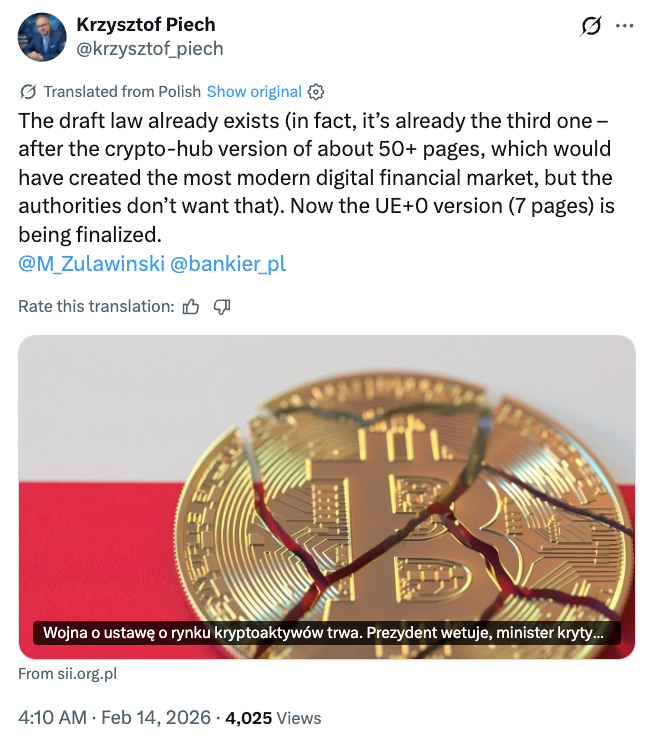
Following the latest veto, Polish economist Krzysztof Piech said he is working on a new, more crypto friendly proposal to implement MiCA in Poland. Piech shared on social media that a draft bill exists and is being finalized, though details have not yet been made public.
For now, uncertainty continues to hang over Poland’s crypto sector. With the MiCA deadline approaching and no clear legislative path at home, companies face mounting pressure to look beyond Poland’s borders to secure their future.