




















































































The US Office of the Comptroller of the Currency has released a sweeping 376 page proposal to implement the Guiding and Establishing National Innovation for US Stablecoins Act, widely known as the GENIUS Act. At the heart of the proposal is a clear position on one of the crypto sector’s most divisive questions: whether payment stablecoins should carry yield.
If finalized in its current form, the rule would bar supervised issuers from offering any form of interest or yield on payment stablecoins. Legal observers say the move could reshape parallel discussions around the Digital Asset Market Clarity Act of 2025, or CLARITY Act, by resolving the yield issue through banking regulation rather than broader market legislation.
The proposal is open for public comment for 60 days following its publication.
A Firm Ban on Yield for Payment Stablecoins
Under the draft rule, entities supervised by the OCC would be prohibited from paying interest, rewards, or yield in any form, whether in cash, tokens, or other consideration, when such payments are connected solely to holding, using, or retaining a payment stablecoin.
The language mirrors section 4(a)(11) of the GENIUS Act, which established a federal framework for payment stablecoins after its enactment in July 2025. The law restricts issuance in the United States to licensed and permitted issuers, including bank subsidiaries, newly chartered federal stablecoin issuers, and certain large state regulated firms.
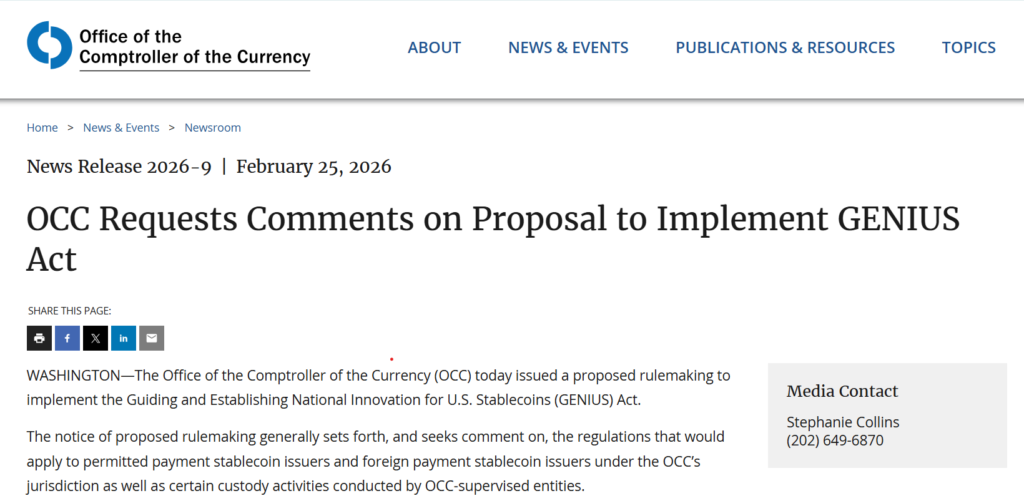
The OCC’s proposal translates that statutory framework into detailed operational rules. It places strict limits on how regulated issuers can structure the economics surrounding their stablecoins, effectively drawing a line between payment instruments and yield bearing crypto products.
Thania Charmani, a partner at global law firm Winston & Strawn, wrote on X that the OCC appears to be settling the stablecoin yield debate through rulemaking. In her view, that could allow the CLARITY Act to move forward without needing to address the issue directly.
Targeting Affiliate Workarounds
Beyond a straightforward ban, the OCC proposal also addresses potential attempts to route yield through affiliated entities.
The draft introduces a rebuttable presumption that an issuer violates the yield prohibition if it pays yield to an affiliate or related third party, and that entity then passes yield on to holders of the issuer’s payment stablecoin.
While issuers would have the opportunity to rebut this presumption by submitting written materials to the OCC, the agency makes its stance clear. It describes such arrangements as highly likely attempts to evade the statute and emphasizes the close nexus between issuer payments and end holder rewards.
In effect, the regulator is signaling that creative structuring will face scrutiny if the economic reality resembles yield on stablecoin balances.
Limited Carve Outs for Merchants and Partnerships
The proposal does not block all incentives connected to stablecoin use. It outlines two explicit carve outs.
First, merchants would remain free to independently offer discounts to customers who choose to pay with payment stablecoins. Such incentives would not be considered yield under the rule, provided they are not tied to issuer funded arrangements.
Second, issuers would not be prevented from sharing profits from stablecoin operations with a non affiliate partner in a white label setup. This allows for commercial partnerships without automatically triggering the yield prohibition, as long as the structure does not result in rewards being paid to stablecoin holders in a way that mirrors interest.
These exceptions suggest the OCC is focused on preventing stablecoins from functioning like deposit accounts, rather than eliminating all business models linked to them.
Implications for the CLARITY Act
The proposal arrives as lawmakers continue debating the CLARITY Act, which seeks to establish broader rules for digital asset markets. One contentious issue in those discussions has been whether digital asset service providers should be allowed to offer yield or rewards on payment stablecoin balances.
Industry participants, including Coinbase, have argued that they should be able to provide yield on stablecoin holdings within a fully regulated US framework. They contend that such rewards are comparable to other financial incentives available in traditional markets.
If the OCC rule is finalized as drafted, it would create a clear baseline: GENIUS compliant, OCC supervised payment stablecoins cannot carry yield at the issuer level. That banking side decision would narrow the room for CLARITY to authorize stablecoin rewards without creating tension between regulatory regimes.
In practical terms, companies seeking to offer yield on stablecoin balances may need to look beyond GENIUS compliant payment stablecoins or adjust their business models to avoid crossing the line set by banking regulators.
A Defining Moment for US Stablecoin Policy
The OCC’s proposal represents a decisive step in shaping how payment stablecoins function within the US financial system. By drawing a firm boundary around yield, the regulator appears intent on preserving a distinction between stablecoins as payment tools and interest bearing financial products.
With a 60 day public comment period now open, industry participants, consumer advocates, and policymakers will have the opportunity to weigh in. The final rule could determine not only how stablecoins are structured, but also how future digital asset legislation, including the CLARITY Act, evolves in response.