

















































































Ethereum has reached a major milestone. The Strategic Ethereum Reserve, a fast-growing collective of long-term ETH holders including public companies, DAOs, foundations, and corporate treasuries has now surpassed $10 billion in assets, marking a 50x growth in just four months. This signals a dramatic increase in institutional confidence in Ethereum as a long-term digital asset.
Ethereum Reserve Grows 50x in Four Months
According to the Strategic ETH Reserve tracking site, the value of Ethereum held by long-term institutional and corporate holders was just $200 million in April 2025. By late June, it had climbed to $3 billion. As of today, the total reserve has hit $10.5 billion, with over $7 billion added in just the past month alone.
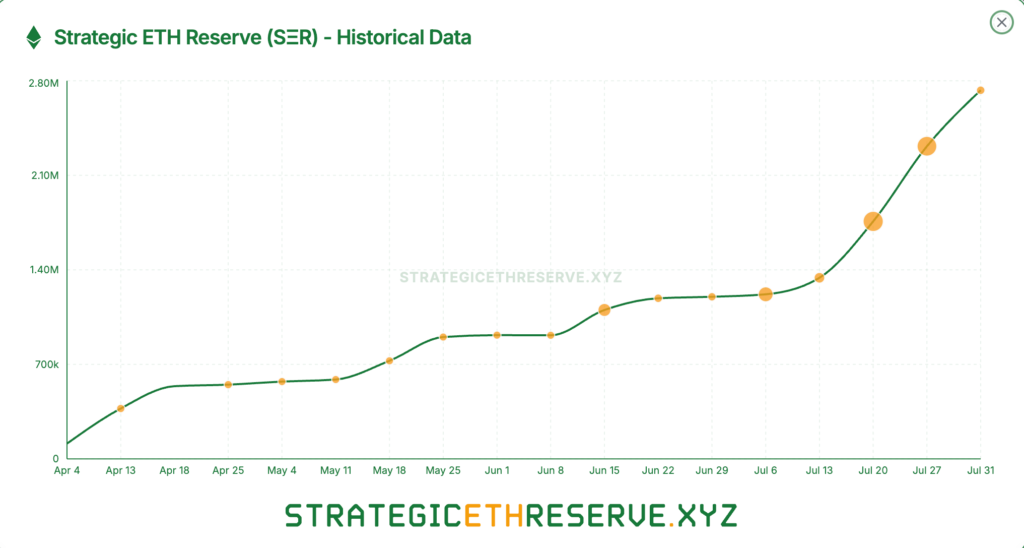
This explosion in holdings is driven by a wave of institutional adoption, with a growing number of public companies now choosing to hold Ethereum as a primary reserve asset. The trend mirrors early Bitcoin adoption by corporate treasuries but appears to be scaling even faster, thanks to Ethereum’s programmable capabilities and staking rewards.
Key Players Behind the Billion-Dollar Reserve
Several major companies have played a leading role in building up the Ethereum Reserve:
- BitMine Immersion Technologies holds the largest ETH position among corporates, with 625,000 ETH, valued at approximately $2.35 billion. The company has stated its long-term goal is to control 5% of all Ethereum in existence.
- SharpLink, another major investor, owns around 438,200 ETH worth $1.69 billion. Remarkably, the firm is sitting on over $400 million in unrealised profits from its ETH holdings.
- A new player, The Ether Machine, emerged on Ethereum’s 10th anniversary. Formed through a planned merger between The Ether Reserve, LLC and Dynamix Corporation, it recently purchased 15,000 ETH for $56.9 million, bringing its total holdings to 334,757 ETH, making it the third-largest ETH corporate holder.
Other firms are gearing up to follow suit. BTCS Inc., a blockchain infrastructure company, has filed with the U.S. SEC to raise up to $2 billion, which it plans to use for further ETH purchases.
Rising Confidence in Ethereum’s Institutional Appeal
According to Vugar Usi Zade, COO of crypto exchange Bitget, ETH is increasingly being seen as more than just a digital asset. Institutions are recognising its long-term value, especially when compared to Bitcoin. Ethereum not only benefits from price appreciation, but also from network utility, programmability, and yield through staking.

“Institutional investment firms are beginning to recognise the potential of ETH, relative to Bitcoin, in terms of price, programmability, network adoption, and access to yield from passive income through staking,” Usi Zade said in a statement to BeInCrypto. He added that this institutional wave is “still in its early stages and likely to accelerate.”
Even smaller firms are joining the trend. 180 Life Sciences Corp. recently announced a plan to raise $425 million to form its own ETH treasury. It also plans to rebrand as ETHZilla Corporation, showcasing a clear shift in corporate identity around Ethereum.
Blockchain Projects Join the Movement
It’s not just traditional corporations that are buying into Ethereum. Blockchain-native projects are also building reserves.
StarHeroes, a multiplayer Web3 game, has launched its own ETH reserve with 410 ETH. The goal isn’t just holding value, it’s also to enhance utility for its native $STAR token, reward long-term holders, and strengthen the ecosystem.
This trend of treasuries being used to support token ecosystems hints at a new way Ethereum can play a role in crypto project sustainability and decentralised economies.
Experts Predict ETH Will Become a Treasury Standard
Silvina Moschini, Founder and CSO of Unicoin, said that Ethereum is evolving into a standard treasury asset, much like sovereign bonds in traditional finance. She emphasised that institutions value Ethereum’s decentralisation, uptime, and security, which provide the kind of certainty and transparency large players need.

“From a trust and execution standpoint, Ethereum delivers the certainty institutional players demand,” Moschini said. “They want guarantees: no preferential treatment, fair execution, and verified finality.”
Additionally, Geoff Kendrick, Head of Digital Assets Research at Standard Chartered, previously forecasted that institutional treasuries could eventually acquire 10% of all ETH in circulation, a significant leap from current levels.
The Ethereum Reserve’s rapid rise to over $10 billion is more than just a number. It signals a fundamental shift in institutional behaviour, where Ethereum is no longer viewed solely as a development platform, but as a core financial asset.
As public companies, blockchain firms, and institutional investors continue to accumulate ETH for long-term strategic purposes, Ethereum may soon find itself playing a central role not only in Web3, but across traditional financial systems and global corporate treasuries.