



















































































Pakistan’s ambitious plan to utilise its surplus electricity for Bitcoin mining has stalled after the International Monetary Fund (IMF) reportedly rejected a proposal to offer subsidised power to energy-intensive sectors, including cryptocurrency operations. The move has raised concerns about potential market distortions and the country’s fragile energy infrastructure.
Subsidised Power Plan Faces IMF Roadblock
According to a report by Urdu-language outlet Independent Urdu, Pakistan’s Secretary of Power, Fakhre Alam Irfan, informed the Senate committee on energy that the IMF had opposed the plan, warning that such subsidies could destabilise the country’s power market. Despite Pakistan having an excess supply of electricity, particularly during winter months, the IMF maintains that subsidised tariffs could undermine energy pricing mechanisms and exacerbate systemic issues in the sector.
The Power Division’s proposal, introduced in November 2024, suggested a marginal-cost tariff of 22 to 23 Pakistani rupees (approximately $0.08) per kilowatt-hour for industries such as copper smelting, data centres, and crypto mining. Proponents argued this would boost electricity consumption, make use of the surplus capacity, and attract foreign investment.
IMF Raises Red Flags on Economic Stability
The IMF’s rejection stems from concerns over long-standing structural imbalances. According to Irfan, the Fund compared the proposed energy subsidies to previous sector-specific tax breaks that have historically contributed to economic instability in Pakistan. These warnings come at a time when the country remains heavily reliant on IMF financial support to stabilise its economy and manage public sector debt.
Although the IMF has not issued an official public response, the Pakistani government has acknowledged that all major policy decisions in the energy sector require IMF approval under existing agreements.
Plan Under Review by World Bank and Global Partners
While the IMF’s stance has cast uncertainty over the future of the mining initiative, officials insist the proposal is not entirely shelved. Irfan confirmed that the plan is currently under review by the World Bank and other international partners. The government is working to revise the framework based on their feedback, with hopes of developing a model that can address the concerns raised.
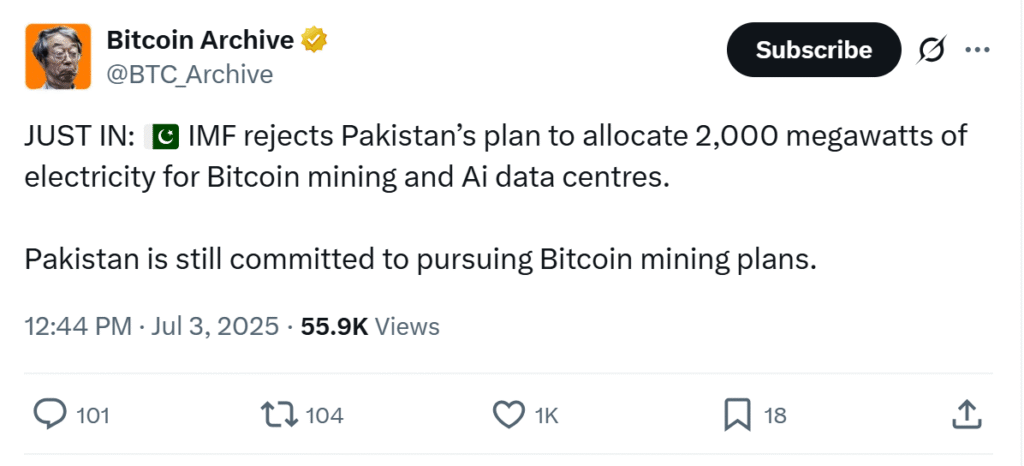
The initial proposal was part of a broader initiative aimed at digitally transforming Pakistan’s economy, spearheaded by the Pakistan Crypto Council and backed by the Ministry of Finance. In May, the government earmarked 2,000 megawatts of surplus electricity for use by Bitcoin mining and artificial intelligence (AI) centres.
Finance Ministry Offers Incentives to Crypto Sector
In a bid to position Pakistan as a regional hub for emerging technologies, Finance Minister Muhammad Aurangzeb had earlier announced a series of incentives for the digital sector. These included tax breaks for AI-focused operations and duty exemptions for Bitcoin miners, aimed at attracting global investment and fostering innovation.
The plan originated from a March meeting hosted by the Pakistan Crypto Council, where council chair Saqib proposed using runoff electricity for Bitcoin mining. The event brought together influential stakeholders, including lawmakers, the governor of the State Bank of Pakistan, the chairman of the Securities and Exchange Commission, and the federal IT secretary.
Bitcoin Reserve and DeFi Strategy in the Works
At the Bitcoin 2025 conference, Saqib unveiled Pakistan’s longer-term goal of creating a national Bitcoin reserve. He shared that conversations with industry leaders, including Michael Saylor of MicroStrategy, had reinforced his belief in the initiative.
To support this vision, Saqib outlined plans to use decentralised finance (DeFi) protocols to generate yield and grow Pakistan’s Bitcoin holdings. This move reflects a growing interest in leveraging blockchain-based financial tools to create alternative revenue streams for the state.
Despite the current hurdles, Pakistan’s leadership remains committed to exploring opportunities in the digital asset space. However, the success of these efforts will largely depend on gaining the support of international financial institutions and ensuring energy policy reforms align with broader economic goals.