




















































































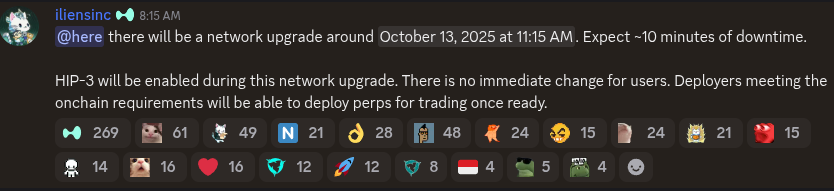
Hyperliquid, a leading decentralised exchange (DEX), has taken a significant step towards fully decentralised derivatives trading with the launch of its HIP-3 upgrade. The update enables third-party builders to independently deploy perpetual futures markets, marking a pivotal shift in how trading infrastructure can be created and accessed within decentralised finance (DeFi).
A New Era of Market Deployment
With HIP-3 now live on mainnet, any user staking 500,000 HYPE tokens (valued at approximately $20.5 million) can launch bespoke perpetual swap contracts. These markets are fully customisable, allowing deployers to define core parameters such as margining systems, orderbooks, leverage limits and pricing oracles. Builders may also set a fee share of up to 50% on top of the base rate, creating new revenue models within the platform.
From Gatekeeping to Permissionless Infrastructure
The upgrade signals a departure from traditional exchange models where only operators control asset listings. Blockchain infrastructure firm QuickNode highlighted that HIP-3 removes human gatekeepers, replacing them with code-based governance. This shift empowers teams to bring new markets to life rapidly while maintaining quality and user safeguards through on-chain rules.
Chainsight, a blockchain analytics platform, echoed this sentiment, noting that Hyperliquid is evolving from a singular exchange into open financial infrastructure. The move is expected to encourage innovation by allowing virtually any data feed to be transformed into a tradable instrument.
Expanding the Scope of Tradable Assets
Perpetual swaps, which mimic futures contracts without expiry dates, have long been popular for leveraged trading. With HIP-3, these instruments can now extend beyond standard cryptocurrency pairs. Builders may introduce assets tied to realised volatility, foreign exchange indices, stock baskets or even pre-IPO valuations. Exotic derivatives, such as correlation swaps, may also emerge as new trading categories.
Synthetic markets protocol Ventuals is among the first to explore these possibilities. It aims to create perpetual markets tracking private company valuations, offering traders exposure to firms before they reach public markets.
Economic Incentives for Builders
The proposal removes listing fees commonly seen on centralised platforms, lowering barriers to entry. By sharing core infrastructure, HIP-3 reduces operational costs while allowing market creators to earn through fee-sharing mechanisms. QuickNode’s analysis suggests this design promotes higher execution quality and increased volume, further subsidising builders through sustained revenue flows.
Long-Term Impact on DeFi
The HIP-3 launch follows months of testing on Hyperliquid’s testnet and represents a foundational shift in DeFi derivatives. By enabling permissionless market creation, Hyperliquid invites entrepreneurs, analysts and institutions to design markets that reflect emerging financial trends. This evolution may catalyse the birth of entirely new asset classes, positioning Hyperliquid as a cornerstone of next-generation financial infrastructure.