























































































From structured Bitcoin lending entering traditional markets to fresh momentum around US crypto regulation and miners doubling down on artificial intelligence, today brought a mix of finance, policy and strategy shifts that could shape the sector in the months ahead.
Ledn brings Bitcoin-backed loans to mainstream debt markets
Bitcoin-backed lender Ledn has completed what is being described as a first-of-its-kind securitization, selling roughly $188 million worth of bonds tied to Bitcoin-collateralized consumer loans. The transaction moves crypto-linked credit risk into the conventional asset-backed securities market, a space typically dominated by auto loans and credit card receivables.
According to a report by Bloomberg, the deal included two tranches, with the investment-grade portion priced at about 335 basis points over a benchmark rate. This pricing suggests investors are demanding a notable premium to hold exposure connected to crypto-backed borrowing rather than standard consumer debt.
The structure, known as Ledn Issuer Trust 2026-1, bundles more than 5,400 short-term, fixed-rate balloon loans issued to nearly 3,000 US borrowers. These loans are backed by just over 4,000 Bitcoin held as collateral, based on preliminary documentation from S&P Global Ratings dated Feb. 9.
Balloon loans keep regular payments relatively low but require a large final payment at maturity, which can amplify risk if market conditions shift. Founded in 2018, Ledn says it has originated over $9.5 billion in loans across more than 100 countries. The company also received a strategic investment from Tether in late 2025, adding to its profile within the digital asset lending space.
US CLARITY Act gains momentum in Washington
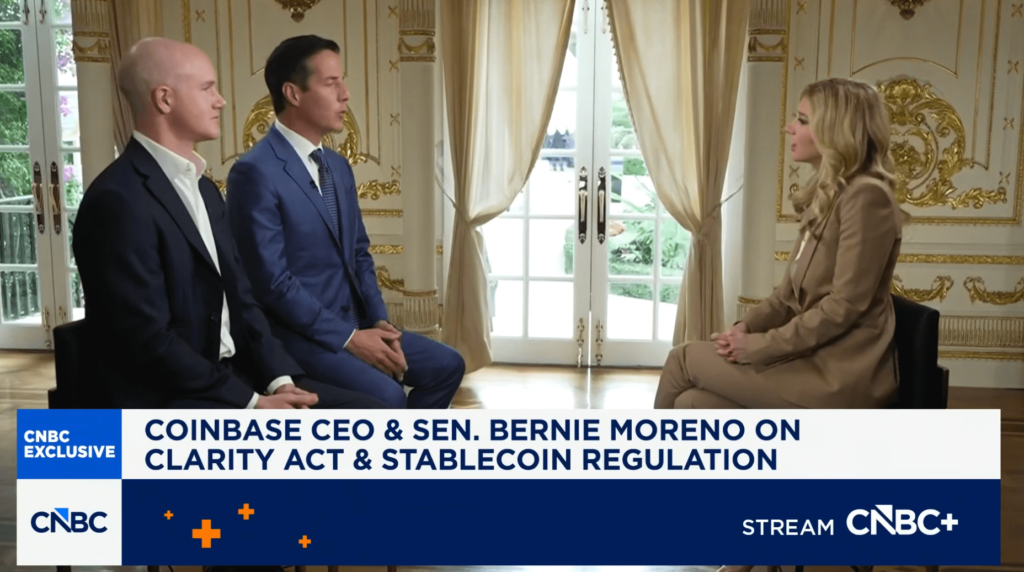
On the regulatory front, optimism is building around the US CLARITY Act, a bill aimed at defining market structure and regulatory responsibilities for the crypto industry. US Senator Bernie Moreno said he expects the legislation to move quickly through Congress.
Speaking to CNBC during an interview at a property owned by US President Donald Trump in Florida, Moreno said the bill could pass as early as April. The comments came amid growing pressure from industry leaders and lawmakers to provide clearer rules for digital assets.
Brian Armstrong, chief executive of Coinbase, joined Moreno for the discussion. He said conversations at the World Liberty Financial crypto forum brought together voices from crypto firms, banks and Congress to find common ground on issues such as stablecoins and consumer protections.
One sticking point has been the idea of stablecoin rewards or yields. Traditional banks have argued that yield-bearing stablecoins could pull deposits away from the banking system, potentially reshaping how consumers save and earn interest. Lawmakers are now weighing how to balance innovation with financial stability as they finalize the bill.
Activist investor pushes Riot toward AI and HPC
In the mining sector, Riot Platforms is facing pressure from an activist shareholder to accelerate its move beyond Bitcoin mining. Starboard Value, which owns roughly 12.7 million shares of Riot, sent a letter to company executives urging faster execution on artificial intelligence and high-performance computing projects.
Starboard estimates that Riot’s Texas-based data center assets could contribute between $9 billion and $21 billion in equity value if fully developed for AI and HPC use. The firm stressed that speed matters, pointing to rising demand for large-scale computing infrastructure and intense competition for premium tenants.
With around 1.4 gigawatts of capacity still available, Starboard argued that Riot is well positioned but must move quickly to secure meaningful, long-term deals. The investor said the company should be able to attract tenants for tier-3 data centers on terms comparable to, or better than, similar transactions announced toward the end of 2025.
AMD deal seen as a starting point, not the finish line
Starboard acknowledged that Riot’s recently announced agreement with Advanced Micro Devices is an encouraging sign. The January deal, which covers data center leasing and related services, was described as proof that Riot’s sites have strong underlying value.
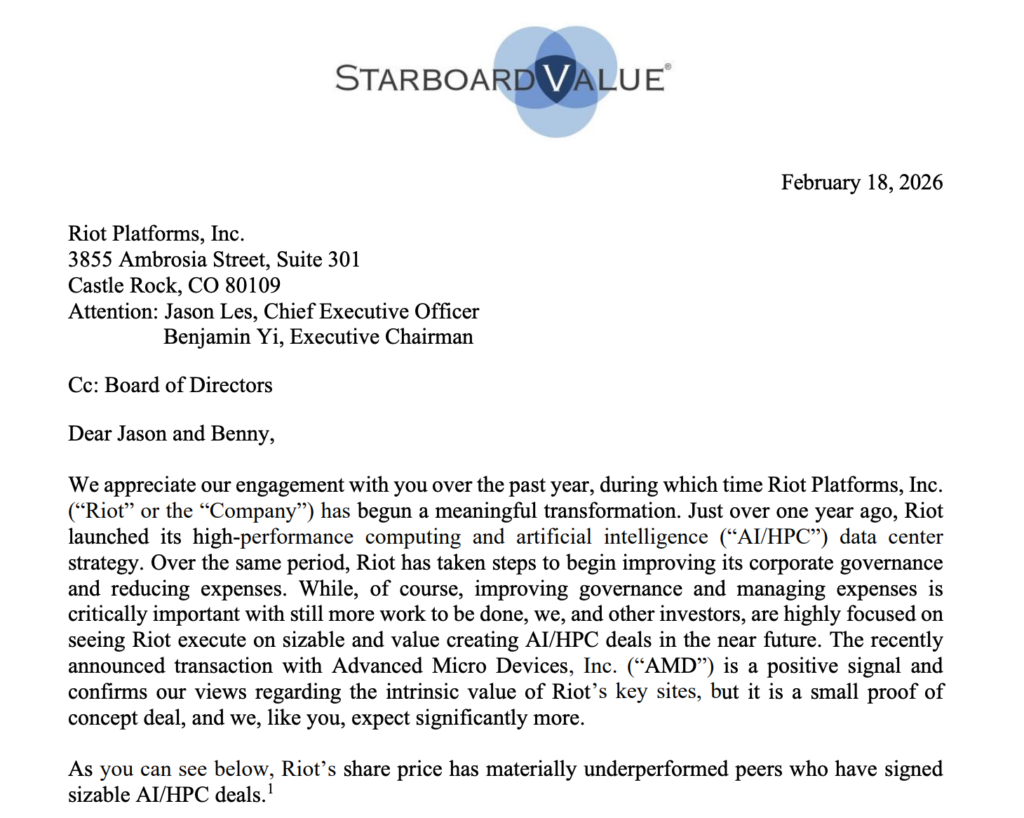
However, the investor made it clear that one agreement is not enough. In its view, the AMD transaction is a small initial step, and significantly larger and more impactful deals should follow as Riot deepens its push into AI and HPC infrastructure.
Taken together, today’s developments highlight how crypto is increasingly intersecting with traditional finance, US policy debates and the fast-growing AI economy. As digital asset firms test new structures and lawmakers race to catch up, the lines between crypto, capital markets and computing continue to blur.