
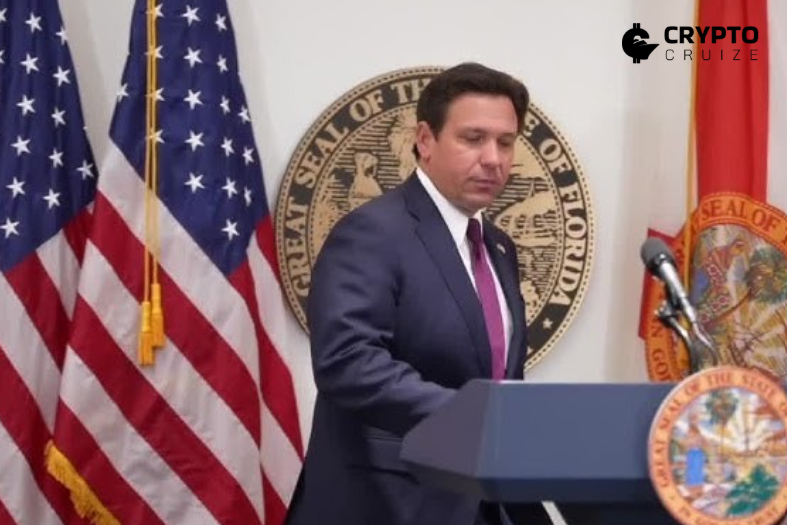
Florida has moved a step closer to creating a clear regulatory framework for payment stablecoins after the state Senate unanimously approved Senate Bill 314. The legislation now heads to Governor Ron DeSantis for final approval and is expected to be signed into law within the next month.
The bill introduces rules for stablecoin issuers operating in Florida and updates existing financial regulations to include digital payment tokens. Industry observers believe the move reflects the state’s growing interest in integrating blockchain-based financial tools while maintaining oversight and consumer protection.
Senate Bill 314 Clears Legislature
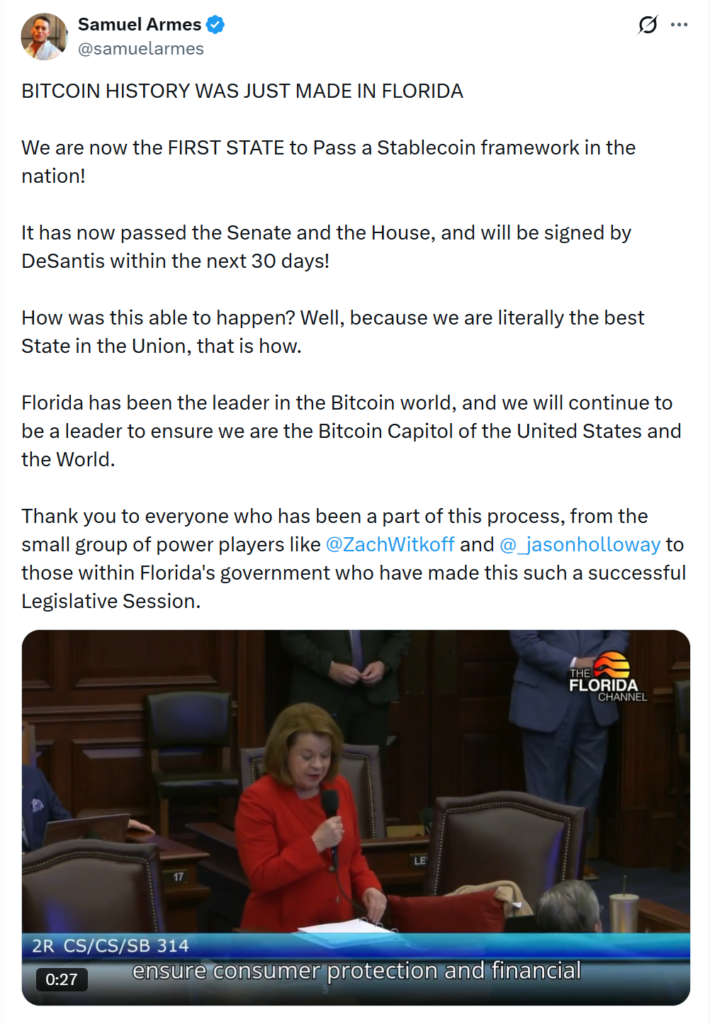
The update was confirmed by Samuel Armes, founder of the Florida Blockchain Business Association, who shared on X that SB 314 had successfully passed both chambers of the state legislature.
According to Armes, the legislation has cleared the Florida Senate after previously passing the House, meaning the final step is the governor’s signature. He indicated that the approval could come within the next 30 days.
Once signed, the law will establish formal regulatory standards for companies issuing payment stablecoins in Florida, bringing them under the state’s financial services rules.
Stablecoins Added to Money Services Regulations
A major component of SB 314 is the amendment of Florida’s Control of Money Laundering in Money Services Business Act to explicitly include stablecoins. By doing so, the state ensures that companies issuing these digital tokens must follow the same regulatory requirements as other financial service providers.
The legislation prohibits the issuance of stablecoins in Florida without proper licensing. This step is intended to prevent unauthorized entities from creating or circulating digital tokens that could pose risks to consumers or the financial system.
The bill also clarifies the legal classification of certain payment stablecoins. Under the new framework, some of these tokens will not be treated as securities, a distinction that could reduce regulatory uncertainty for issuers and developers working in the state.
Oversight for Local and Out-of-State Issuers
SB 314 introduces oversight mechanisms depending on where the stablecoin issuer is based. Companies operating from outside Florida must notify the state’s Office of Financial Regulation before conducting business in the state.
Regulatory supervision will differ depending on the issuer’s structure. Some operators will be regulated solely by the Office of Financial Regulation, while others may fall under joint oversight involving the Office of the Comptroller of the Currency.
This dual supervision approach is meant to ensure that both state and federal regulators can monitor activities tied to stablecoin issuance and circulation.
Restrictions on Interest and Incentive Payments
The legislation also addresses the growing practice of offering financial incentives to stablecoin holders. Under SB 314, qualified issuers will not be allowed to provide interest or yield payments to users if such incentives are prohibited under federal law.
Lawmakers included this clause to prevent stablecoins from operating like unregulated savings products, which could introduce additional financial risk.
The bill’s consumer protection provisions are also aligned with the GENIUS Act, a federal law signed earlier in July that established national guidelines for stablecoin oversight.
Florida Considers Broader Crypto Integration
Florida lawmakers are also exploring ways to incorporate digital assets into the state’s financial strategy. A separate proposal, Florida House Bill 183, aims to allow the state and certain public entities to allocate up to 10 percent of their funds into digital assets.
The revised measure expands beyond Bitcoin to include crypto exchange-traded products, crypto securities, non-fungible tokens, and other blockchain-based assets.
The proposal is a renewed attempt following the withdrawal of Florida House Bill 487 in June after it failed to move forward in a House operations subcommittee.
Together, these legislative efforts suggest Florida is positioning itself as an active participant in the digital asset economy while attempting to balance innovation with regulatory oversight.