


















































































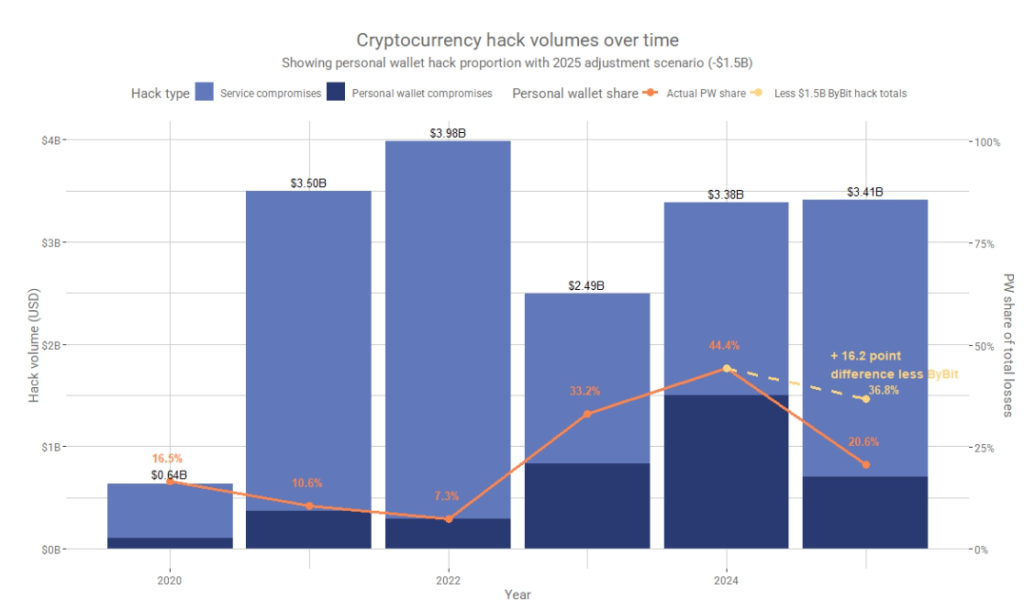
Global cryptocurrency losses reached an estimated 3.4 billion dollars in 2025 as hackers increasingly targeted major platforms and high value wallets, according to a new report by blockchain analytics firm Chainalysis. The figure marks the highest annual total since 2022, driven largely by a small number of extremely large attacks rather than a broad rise in hacking activity.
A handful of attacks drove most losses
Chainalysis found that just three major incidents accounted for nearly seventy percent of all crypto losses recorded between January and early December 2025. The largest of these was the 1.4 billion dollar hack of crypto exchange Bybit, which alone reshaped the annual figures.
The report noted that the biggest attacks this year were up to a thousand times larger than the average incident. This concentration of damage highlights a growing strategy among attackers to focus on high value targets capable of delivering outsized returns.

Andrew Fierman, head of national security intelligence at Chainalysis, said that such events make yearly trends difficult to predict. He explained that one or two exceptional breaches can push annual losses to record levels. Despite this uncertainty, he added that there is little evidence to suggest hacking activity will ease in 2026.
Hackers increasingly target personal wallets
While large exchanges dominated headline figures, hackers also showed renewed interest in personal crypto wallets. Wallet and private key compromises accounted for about twenty percent of total stolen value in 2025. Without the Bybit incident, this share would have risen to nearly thirty seven percent.
The proportion of losses linked to personal wallets has fluctuated sharply in recent years. They made up just over seven percent of stolen funds in 2022 before rising to forty four percent in 2024. Although the share fell this year, personal wallets remain a significant area of risk.
Despite the rise in incidents, the total value stolen from individual wallet hacks fell from 1.5 billion dollars in 2024 to around 713 million dollars in 2025. Fierman attributed this to the relatively small balances typically held in personal wallets compared with large exchange wallets that pool funds from many users.
DeFi security shows signs of improvement
Decentralised finance did not experience a corresponding rise in losses, despite a strong market recovery. Total value locked in DeFi protocols has climbed to around 119 billion dollars, more than double the lows seen in 2023, according to DefiLlama.
Historically, periods of rising capital in DeFi have attracted more attacks. This year, however, Chainalysis observed a clear break from that pattern. The firm said improved security practices across DeFi protocols have helped contain losses, even as billions of dollars flowed back into the sector.
Attackers also appear to be shifting their attention away from DeFi towards wallets and centralised services, further easing pressure on decentralised platforms.
North Korean hackers grow more sophisticated
North Korean hacking groups were responsible for an estimated 2.02 billion dollars in stolen cryptocurrency in 2025. This represents an increase of 681 million dollars compared with 2024, making the country the single largest source of crypto theft this year.
Chainalysis found that these groups carried out fewer attacks but caused significantly more damage per incident. The shift reflects greater patience, planning and technical sophistication. Tactics included embedding information technology workers within crypto projects and exploiting weaknesses through third party vendors.
Fierman warned that while the industry continues to learn from each breach and strengthen its defences, North Korean groups are also evolving rapidly in search of new attack routes to fund the regime.