




















































































A sharp fall in Bitcoin’s computing power has been linked to the shutdown of large scale mining operations in China’s Xinjiang region, according to a former senior executive at mining hardware firm Canaan. The drop has renewed debate about China’s unstable role in the global Bitcoin mining industry and highlighted the growing dominance of the United States in the sector.
Sudden fall in network hashrate
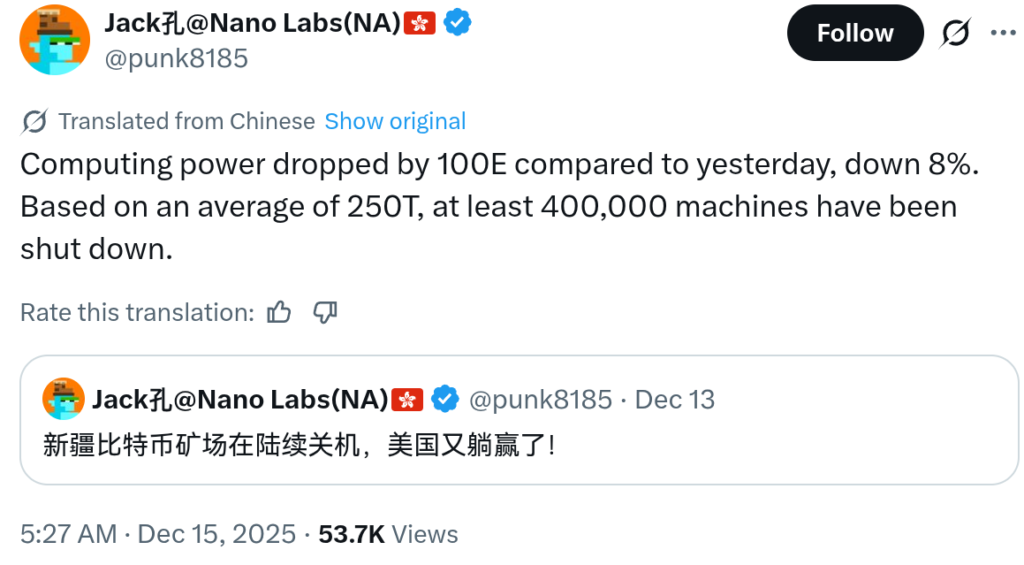
Bitcoin’s hashrate fell by roughly 10 percent within a single day on Sunday, marking one of the steepest short term declines in recent months. Jianping Kong, former co chairman of Chinese Bitcoin mining hardware producer Canaan, claimed the fall was caused by the shutdown of a significant number of mining machines in China.
In a post on social media platform X on Monday, Kong said the network lost around 100 terahashes per second since Sunday. He estimated that at least 400,000 mining rigs had gone offline, based on an assumed average output of 250 terahashes per application specific integrated circuit miner.
While these claims could not be independently verified, Kong’s former position at a major Chinese ASIC manufacturer lends weight to his assessment. Bitcoin’s total hashrate cannot be measured directly and is instead inferred from network data, meaning short term estimates can vary.
Data supports sharp decline
According to figures from market data provider YCharts, Bitcoin’s hashrate dropped from about 1,053 terahashes per second on Sunday to just under 943 terahashes per second on Monday. This represents a loss of more than 110 terahashes per second, broadly aligning with Kong’s claims.
Although the decline appears dramatic, analysts caution that hashrate estimates can fluctuate due to changes in mining difficulty, block discovery times and temporary shutdowns linked to power issues or regulatory action.
China’s unstable role in Bitcoin mining
China has long played a central yet unpredictable role in Bitcoin mining. Before 2021, the country accounted for roughly 65 percent of the global hashrate. That dominance ended when Chinese authorities moved to ban mining activities, forcing many operators to relocate overseas.
Despite the ban, mining activity has gradually resumed across parts of China. Data from Hashrate Index in October 2024 suggested China accounts for about 14 percent of global Bitcoin mining. CryptoQuant estimates place the figure slightly higher, between 15 and 20 percent.
A recent Reuters report noted that both individual miners and larger firms continue to exploit cheap electricity in parts of China, operating in a legal grey area. Kong criticised this situation, arguing that the sudden shutdowns in Xinjiang once again expose China as an unreliable source of hashrate. He added that these disruptions effectively hand an advantage to the United States without any direct action.
United States strengthens mining dominance
As China’s mining sector faces renewed uncertainty, the United States continues to expand its domestic Bitcoin mining industry. In August, mining firm Hut 8 announced plans to build four new mining facilities across Texas, Louisiana and Illinois, adding a combined 1.5 gigawatts of capacity.
Hut 8 is the parent company of American Bitcoin, a mining and treasury firm linked to the Trump family. The company went public through a merger in early May, with Eric Trump joining its board of directors. The move has reinforced perceptions that US political and business leadership is increasingly supportive of Bitcoin mining.
Rising scrutiny of Chinese mining hardware
Alongside its mining expansion, the United States is also increasing pressure on Chinese mining hardware suppliers. In late November, reports emerged that US authorities had launched a national security investigation into a China based Bitcoin ASIC manufacturer.
The probe is reportedly examining whether mining hardware could be remotely controlled to spy on or disrupt the US power grid. Any restrictions resulting from the investigation could have wider implications, including for American Bitcoin, which previously acquired more than 16,000 Antminer units from Chinese supplier Bitmain.
Earlier scrutiny has also targeted Chinese chip designer Xiamen Sophgo over alleged links to sanctioned firm Huawei. In November, US Customs authorities halted deliveries of thousands of Bitmain mining machines, only beginning to release them several months later.
A shifting global mining balance
The latest hashrate drop underscores how quickly regulatory or operational changes in China can affect the Bitcoin network. At the same time, the steady growth of mining infrastructure in the United States suggests a longer term shift in global mining power away from China.
As Bitcoin mining becomes more closely tied to geopolitics, energy security and national policy, sudden disruptions like the Xinjiang shutdowns are likely to carry increasing significance for the network as a whole.