


















































































Spot Bitcoin and ETH ETFs experienced sharp outflows on Friday, following the release of new US inflation data. The figures showed that core price pressures are edging higher, driven in part by President Donald Trump’s tariff regime.
ETFs Turn Red After Inflation Data
According to SoSoValue, Ether ETFs recorded a net outflow of $164.64 million, marking their first daily decline after five straight sessions of inflows. Those previous inflows had brought in more than $1.5 billion, signalling strong institutional demand before the setback.
Bitcoin ETFs also posted losses, registering $126.64 million in outflows, their first negative day since 22 August. The combined market value of Ethereum ETFs now stands at $28.58 billion, while Bitcoin ETFs hold around $139.95 billion in assets under management.
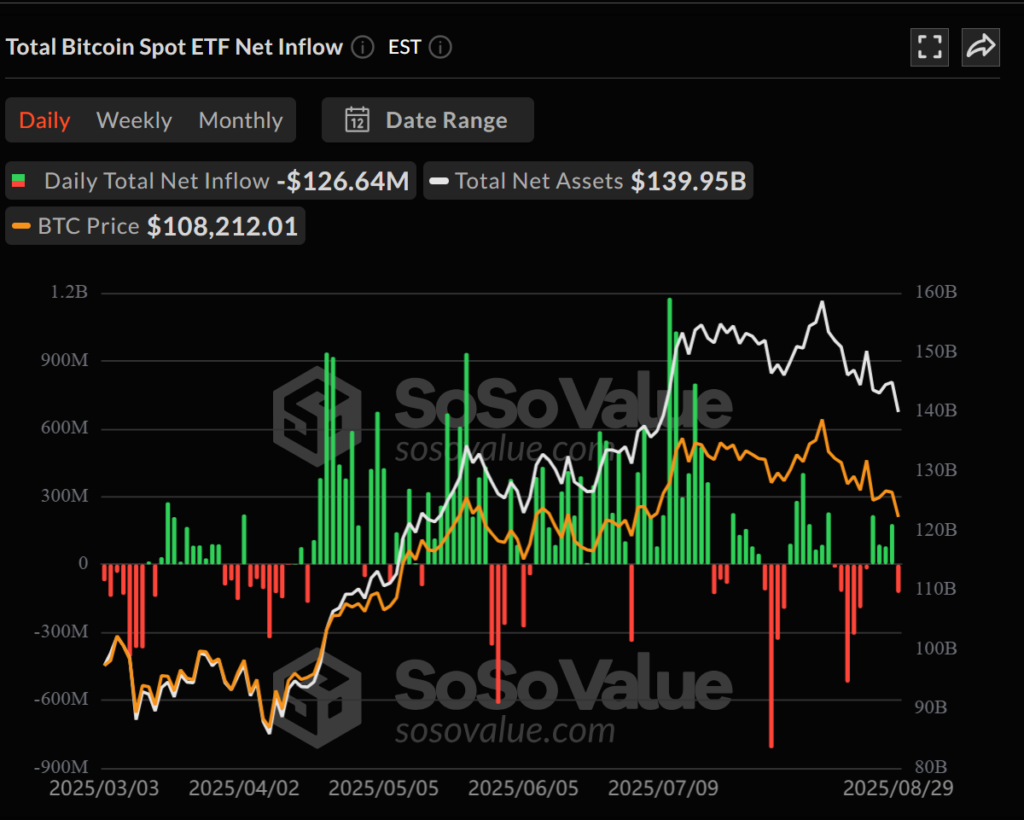
Fidelity’s FBTC fund was the hardest hit, with a $66.2 million withdrawal. ARK Invest and 21Shares’ ARKB saw $72.07 million exit, while Grayscale’s GBTC recorded $15.3 million in redemptions. Only a few funds managed to buck the trend, with BlackRock’s IBIT attracting $24.63 million and WisdomTree’s BTCW adding $2.3 million.
Fed’s Core Inflation Gauge Surprises
The outflows closely followed the Federal Reserve’s release of its preferred inflation measure, the core Personal Consumption Expenditures (PCE) index. The report showed a 2.9% annualised rise in July, the highest reading since February and slightly above the Fed’s comfort zone.
While the headline number matched forecasts, analysts noted that underlying drivers pointed to fresh challenges. Services inflation jumped 3.6% year-on-year, while higher import costs linked to Trump’s tariffs added to pressure on consumer prices.
The Trump administration has introduced a baseline 10% tariff on all imports, alongside targeted reciprocal duties on certain goods. Though cheaper energy helped limit broader inflation, the tariff-led rise in services and goods prices has drawn attention from investors and policymakers.
Despite the uptick in inflation, markets still expect the Fed to consider a rate cut at its next meeting, particularly if labour market data signals further weakness. However, Friday’s PCE report has complicated the central bank’s decision-making process.
Ether ETFs: From Growth to Setback
The sudden reversal comes after Ether spot ETFs had enjoyed strong momentum since their launch in July 2024. Inflows surged 44% in August, rising from $9.5 billion to $13.7 billion. Analysts had credited this rally to a rebound in institutional confidence, following Ethereum’s prolonged underperformance against Bitcoin earlier in the year.
Corporate treasury adoption of Ether has been another major driver. Companies now hold around 4.4 million ETH, worth more than $19 billion, representing 3.7% of the total supply, according to data from StrategicETHReserve.

Commenting on the trend, Fabian Dori, CIO of Sygnum Bank, noted:
“After an extended period of underperformance relative to Bitcoin and a souring investor sentiment, Ethereum has recently experienced a significant revival in the recognition of both its adoption rate and value proposition.”
Market Outlook: Short-Term Pressure, Long-Term Interest
The outflows highlight the fragile balance in crypto markets between macroeconomic headwinds and institutional adoption. Rising inflation amplified by tariffs has raised concerns about near-term volatility, prompting some investors to reduce risk exposure.
However, the broader trajectory of Bitcoin and Ethereum ETFs still points to strong institutional engagement. The inflows into Ether ETFs in August and continuing corporate accumulation underline growing long-term interest in the asset class.
For now, much hinges on the Fed’s next policy move. A dovish stance with rate cuts could renew inflows into risk assets, including digital currencies. But if inflation proves sticky under Trump’s trade policies, both Bitcoin and Ether ETFs could face further outflow pressure.