


















































































Crypto custody heavyweight BitGo has filed for an initial public offering (IPO) in the United States, aiming to list on the New York Stock Exchange (NYSE) under the ticker BTGO. The move underscores the momentum of digital asset firms entering public markets as institutional adoption accelerates under favourable US policy shifts.
BitGo Targets Wall Street Listing
On 18 September 2025, the Palo Alto-based firm submitted its S-1 registration to the US Securities and Exchange Commission (SEC). The filing revealed plans to offer Class A common stock, each carrying one vote, while CEO and co-founder Michael Belshe will retain control through Class B shares carrying 15 votes each.

This dual-class structure ensures that BitGo will remain a “controlled company” under NYSE rules, exempting it from certain corporate governance requirements. According to the filing, Belshe will maintain decision-making authority on key matters including director elections and potential change-of-control transactions.
BitGo stated that the IPO aims to raise capital, increase visibility and strengthen financial flexibility. Proceeds will be used for technology development, working capital, potential acquisitions and covering stock-based compensation taxes.
Custody Giant With Global Reach
As of 30 June 2025, BitGo reported $90.3 billion in assets under custody (AUC), serving more than 4,600 clients and 1.1 million users across over 100 countries. The platform supports more than 1,400 digital assets, from Bitcoin and Ethereum to Solana, XRP and newer networks like Sui.
Despite its wide coverage, the firm’s custody remains concentrated in five major tokens Bitcoin, Ethereum, Solana, XRP and Sui, which account for over 80% of assets held. Staking activity is also focused on Sui, Solana and Ethereum, reflecting institutional preferences for high-liquidity networks.
BitGo has expanded globally with licences in the European Union, Singapore and Germany. Its European arm recently received an extended licence from BaFin, enabling trading, custody, staking and transfers under the EU’s Markets in Crypto-Assets (MiCA) framework. The firm is also pursuing a US banking charter to strengthen its regulatory footing.
BitGo backs its operations with $250 million in insurance coverage and has completed SOC 1 and SOC 2 audits, aiming to reassure institutions on security and compliance.
Revenue Surge But Thin Margins
Financial disclosures highlight BitGo’s rapid growth but also its profitability challenges.
In the first half of 2025, the company generated $4.19 billion in revenue, nearly quadruple the $1.12 billion earned during the same period in 2024. Yet, net income fell to $12.6 million, less than half of the $30.9 million recorded last year.
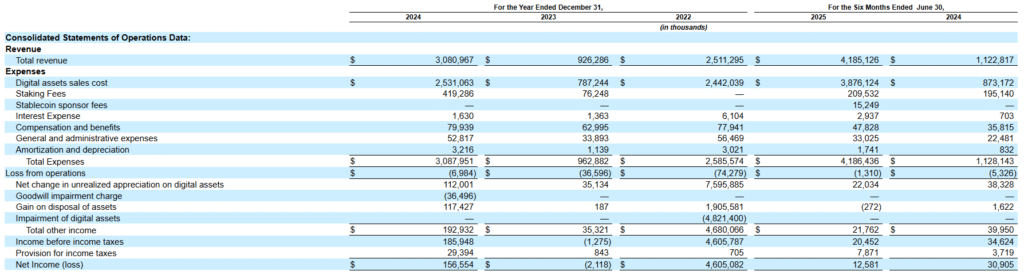
The rising costs of scaling custody, staking and trading services for institutions have weighed heavily on margins. Industry observers see this as a balancing act between expanding infrastructure and delivering sustainable profits.
Commenting on the numbers, Bobby Ong, co-founder of CoinGecko, noted:
“Only $12 million in profit on the back of $4 billion in revenue – such low profit numbers. Revenue increased by $3 billion, but profits dropped by more than half. Surely these guys can do much better. Good that they are going public. More public crypto companies is good for the industry and I’m curious how high they will be valued.”
Broader Wave of Crypto IPOs
BitGo’s filing comes amid a surge in crypto firms seeking Wall Street listings in 2025. Stablecoin issuer Circle, exchange operator Bullish, lending platform Figure and custodial rival Gemini have all announced or completed IPOs this year. Grayscale has also filed for a public listing.
Industry leaders argue that this new wave of IPOs highlights the scale of digital asset businesses. Hunter Horsley, CEO of Bitwise, wrote on X that almost $100 billion in combined market capitalisation has already emerged from the listings, calling it proof that “crypto is an industry.”
Meanwhile, US banks are re-entering the space. US Bancorp relaunched its digital asset custody services earlier this month after the Trump administration rolled back SEC rules that previously required banks to hold extra capital against crypto activities. The service, first launched in 2021 with NYDIG, had been paused due to compliance constraints but is now being revived for institutional managers.
Outlook: BitGo’s Next Chapter
BitGo has long been viewed as a backbone of institutional crypto infrastructure. With over $90 billion in custody, licences in major regions and deep client reach, its IPO marks one of the sector’s most significant steps onto Wall Street.
Yet, challenges remain. Heavy concentration in a handful of assets, wafer-thin margins and reliance on issuer trust for tokenised products raise questions about sustainability. At the same time, the broader wave of crypto IPOs suggests a growing appetite among investors for exposure to the infrastructure powering digital finance.
If successful, BitGo’s listing could strengthen its position as the leading crypto custodian while helping shape the public market narrative for digital asset firms. As institutional adoption accelerates, BitGo’s Wall Street debut may serve as a bellwether for the next chapter of crypto’s integration with traditional finance.