

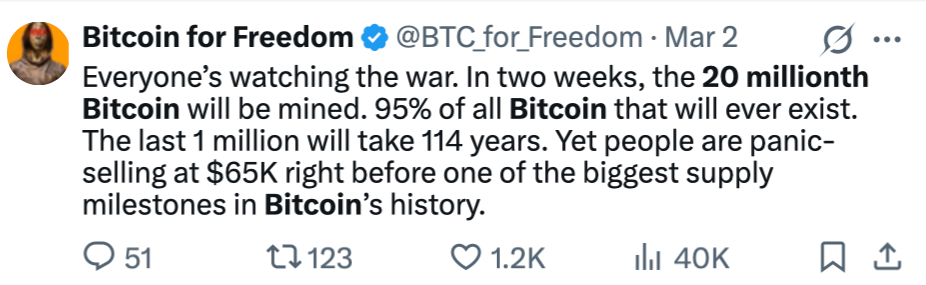
The global cryptocurrency community marked a major milestone as the network behind Bitcoin produced its 20 millionth coin. With this achievement, only one million Bitcoins remain to be mined over the next century, bringing the digital currency closer to its fixed supply cap of 21 million.
The milestone highlights one of Bitcoin’s defining features: a limited and transparent supply. Supporters argue that this scarcity is what gives the cryptocurrency long term value and differentiates it from traditional government issued currencies.
A Limited Supply Built Into the System
Bitcoin was designed with a hard supply cap of 21 million coins, a rule embedded in its code when the network launched in 2009. The mining process releases new coins gradually, following a schedule that is publicly known years in advance.
With the 20 millionth coin now mined, about 95 percent of all Bitcoins that will ever exist are already in circulation. The remaining one million coins will be mined slowly over the next hundred years, with the final coin expected around the year 2140.
Currently, roughly 450 new Bitcoins enter circulation each day. However, this rate does not remain constant. Every four years the network undergoes an event known as the Bitcoin halving, which reduces the mining reward by half. This mechanism steadily slows the supply of new coins entering the market.
Scarcity Seen as Bitcoin’s Core Strength
For many in the crypto industry, Bitcoin’s transparent supply schedule is one of its strongest advantages.
According to Grayscale Investments, the appeal of a digital monetary system with a predictable and limited supply is increasing in today’s economic environment. The firm noted that concerns around inflation and the risks associated with fiat currencies are driving interest in alternative stores of value.
Industry leaders echoed this sentiment. Elektron Energy CEO Raphael Zagury said that the clarity around Bitcoin’s issuance is unlike anything seen in traditional financial systems.
He pointed out that the supply schedule is visible decades into the future, giving users confidence in how the system will evolve. Predictable rules, especially in monetary systems, tend to attract long term trust from users and investors.
Portfolio manager Tommy Rogulj of Swyftx said the milestone strengthens the narrative around Bitcoin as a scarce digital asset. According to him, the countdown toward the final million coins reinforces the characteristics that make Bitcoin unique. It operates as a decentralized asset with a supply that cannot be expanded the way governments can print more currency.
Analysts Say Milestone May Not Move Prices
Despite the symbolic importance of the event, several analysts believe the milestone is unlikely to influence Bitcoin’s price in the short term.
Charles Edwards, founder of Capriole Investments, said the market has long been aware of Bitcoin’s supply schedule. Because the future issuance of new coins is already known, investors have likely factored this information into the market price.
He added that Bitcoin’s supply growth rate is already lower than that of gold, meaning the scarcity narrative is not new to investors.
Zagury shared a similar view, explaining that broader economic conditions and market liquidity typically play a larger role in determining Bitcoin’s price movements. While the milestone is historically significant, he believes it does not immediately change the fundamentals that drive short term trading.
At the time of the announcement, Bitcoin was trading around $68,670, according to data from CoinMarketCap. The cryptocurrency remains below its previous highs and has experienced volatility over the past year.
What Happens After the Last Bitcoin Is Mined
Looking further ahead, many discussions in the crypto community focus on what will happen once the final Bitcoin is mined, which is expected around 2140.
Currently, miners secure the network by validating transactions and adding new blocks to the blockchain. In return, they receive newly minted Bitcoins along with transaction fees paid by users.
When the supply eventually reaches its limit, miners will no longer receive new coins as rewards. Instead, transaction fees will become the main incentive for maintaining the network.
Some observers believe this model will work as long as Bitcoin continues to see widespread use, ensuring that transaction fees remain valuable. Others have raised concerns that higher fees might be required in the future to maintain strong network security.
For now, those debates remain largely theoretical. With more than a century before the final coin is mined, the Bitcoin ecosystem is expected to evolve alongside changes in technology, adoption and global financial systems.
A Milestone That Reinforces Bitcoin’s Identity
Although the 20 millionth coin does not immediately reshape the market, it represents an important checkpoint in Bitcoin’s long journey toward its fixed supply cap.
For supporters, the moment underscores the principles that have defined Bitcoin since its creation: transparency, decentralization and a monetary system governed by code rather than central authority.
As the remaining one million coins are mined over the coming decades, the milestone serves as another reminder of the cryptocurrency’s unique economic design and the role scarcity plays in its long term narrative.