

















































































Bitcoin’s sharp exchange-traded fund outflows in 2026 have rattled sentiment, but some market observers argue the pullback is less a breakdown of the bull case and more a transition phase. As institutional investors trim exposure, a new class of longer-term capital could eventually reshape the market’s structure.
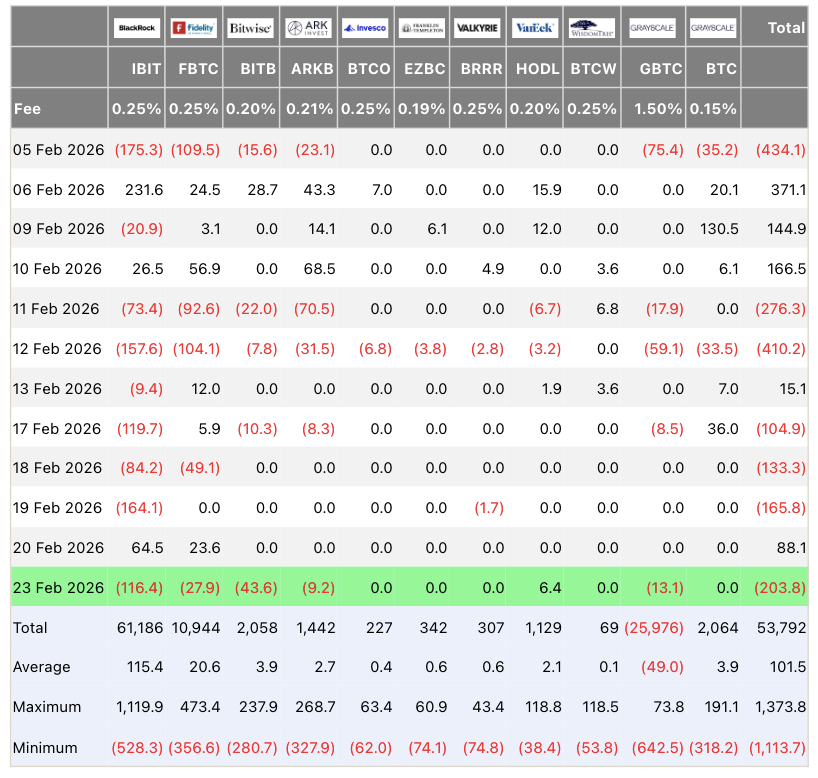
Bitcoin recently traded near $63,000 after slipping from highs around $126,000, with US spot Bitcoin ETFs recording five consecutive weeks of net outflows. According to UK-based investment firm Farside Investors, Monday alone saw more than $200 million leave these products.
ETF Success, Asset Identity Questioned
Eric Jackson, founder of EMJ Capital, believes Bitcoin’s recent weakness reflects its transformation into a mainstream ETF product rather than a failure of the asset itself.
Posting on X, Jackson argued that Bitcoin did not fail as an asset but “succeeded as an ETF,” suggesting that the structure has altered who holds BTC and how it behaves in risk cycles.
Since the approval of US spot Bitcoin ETFs, large institutions have become the dominant marginal buyers. Products such as BlackRock’s BlackRock iShares Bitcoin Trust, iShares Bitcoin Trust, have attracted billions in assets. But that same institutional presence has tied Bitcoin’s price more closely to broader equity flows.
Jackson noted that BTC has recently moved in tandem with iShares Expanded Tech-Software Sector ETF, a technology-focused ETF also managed by BlackRock. In his view, that correlation signals a shift in perception. Instead of behaving like digital gold, Bitcoin is trading like a high-beta technology stock.
When tech stocks sell off, Bitcoin sells off. That dynamic, he argues, undermines the store-of-value narrative in the short term.
Institutional Exit Dominates This Cycle
The current cycle looks very different from previous bull markets. In 2017, retail traders dominated the run to $20,000 before capitulating. In 2021, funds and leveraged players drove Bitcoin to nearly $69,000 before selling into weakness. In 2025 and 2026, ETF allocators appear to be the primary sellers.
This rotation has left Bitcoin vulnerable to macro pressures. With global uncertainty rising and risk assets under strain, ETF holders are reducing exposure alongside other portfolio assets. At the same time, gold has climbed to fresh all-time highs, drawing capital from investors seeking safety.
Jackson characterizes this phase as an “institutional exit,” but he does not see it as the end of the bull thesis. Rather, he views it as a filtering process where shorter-term capital steps aside.
Each cycle, weaker hands are shaken out, he said, and replaced by investors with longer time horizons. In his framework, the market is undergoing a cleansing period that could ultimately strengthen Bitcoin’s ownership base.
Stablecoin Supply as a Bullish Signal
Beyond ETF flows, analysts are watching liquidity indicators for signs of a turnaround. One key metric is stablecoin supply on exchanges, often viewed as dry powder waiting to enter the market.
Jackson believes a renewed expansion in stablecoin balances could signal the return of risk appetite and provide fuel for the next leg higher. Without that liquidity growth, downside pressure may persist.
Data from TradingView shows BTC/USD dipping below $63,000 this week, marking some of its weakest levels since the 15 month lows seen earlier in February. Some market participants are now eyeing macro bottom targets closer to $50,000 if selling continues.
Still, proponents argue that price corrections are part of Bitcoin’s historical pattern. Volatility has accompanied every major adoption wave, from retail speculation to hedge fund participation and now ETF-driven exposure.
A Different Kind of Institutional Capital
Looking ahead, Jackson expects the next wave of buyers to look very different from current ETF allocators. He points to sovereign wealth funds, corporate treasuries and pension funds as potential long-duration holders.
Unlike traditional asset managers who rebalance quarterly, these institutions often deploy capital with multi-year or even multi-decade mandates. If such players enter meaningfully, Bitcoin’s correlation with tech stocks could weaken.
That shift, supporters argue, would reinforce the long-term investment case and reduce the asset’s sensitivity to short-term equity market swings.
For now, however, the market remains in transition. ETF outflows continue, correlations with tech stocks remain elevated and macro uncertainty hangs over risk assets. Whether this phase marks a deeper structural top or a reset before renewed accumulation will likely depend on liquidity conditions and the type of capital that steps in next.
As Bitcoin hovers near key support levels, the debate centers not on whether institutions are involved, but which institutions will ultimately define the next chapter.