

















































































Bitcoin is once again showing technical signals that resemble the early stages of its 2022 bear market, raising fresh concerns among traders and analysts. A recent crossover of long-term moving averages on the weekly chart has triggered comparisons with the period that preceded Bitcoin’s last major downturn. At the same time, Bitcoin’s performance against silver has fallen back to levels last seen during the FTX collapse.
These developments have strengthened fears that the cryptocurrency market may be entering another prolonged period of weakness.
Long-Term Moving Averages Turn Bearish
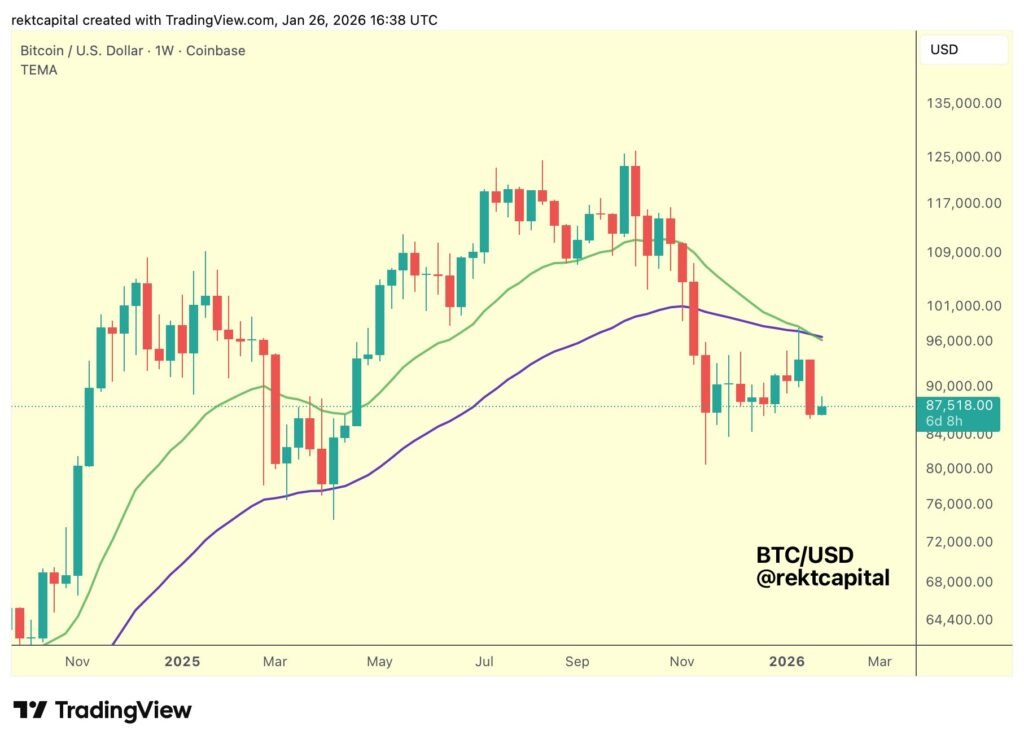
According to market analyst Rekt Capital, Bitcoin has witnessed a bearish crossover between two key indicators: the 21 week exponential moving average and the 50 week exponential moving average. This crossover was confirmed at the close of the latest weekly candle.
Such an event has not occurred since April 2022, a period that marked the beginning of Bitcoin’s most recent major bear market. At that time, the market continued to decline for several months before finally reaching a long-term bottom.
Rekt Capital described the development as a significant shift in market structure, stating that the so-called “bull market” moving averages have now turned bearish. Historically, this type of crossover has suggested weakening momentum and reduced investor confidence.
While technical indicators do not guarantee future outcomes, many traders view this signal as an early warning of deeper price corrections.
Lessons from the 2022 Market Collapse
The last time this crossover appeared, Bitcoin entered a prolonged downturn that lasted for much of 2022. After the signal in April of that year, the price continued to fall before reaching a macro bottom in November at around 15,600 dollars.
That level has not been revisited since and is widely regarded as a defining point in Bitcoin’s recovery. However, the path to that bottom took nearly seven months and was accompanied by major industry disruptions, including the collapse of several high-profile crypto firms.
The similarity between current market conditions and those of early 2022 has raised concerns that history may be repeating itself. Some analysts believe that if the pattern holds, Bitcoin could experience an extended period of consolidation or decline before stabilising.
Four Year Cycle and 2026 Outlook
Bitcoin’s price movements have often been linked to a four year cycle that is associated with its halving events. Under this theory, major bull and bear markets tend to follow a relatively predictable rhythm.
The previous bear market in 2022 aligned closely with this cycle. Now, with another bearish crossover emerging roughly four years later, some analysts argue that the market is once again following its historical pattern.
Rekt Capital suggested that this supports the idea of a “textbook” bear market leading into 2026. Despite doubts about the relevance of the four year cycle, especially after weak performance in late 2025, many traders continue to monitor it closely.
Recent projections indicate that Bitcoin may face strong resistance around the 65,000 dollar level. A failure to hold above this zone could intensify selling pressure and reinforce bearish sentiment.
Bitcoin Weakens Against Silver
Adding to the negative outlook is Bitcoin’s declining performance relative to silver. Trader Daan Crypto Trades highlighted that the Bitcoin to silver ratio has fallen back to levels last seen during the FTX collapse in 2022.
At that time, the sudden failure of the major cryptocurrency exchange triggered a market-wide crash and severely damaged investor confidence. The current ratio suggests that Bitcoin has once again lost ground to precious metals as a store of value.
Daan Crypto Trades described the chart as “insane,” noting that silver has achieved this relative performance in roughly half the time it took Bitcoin to complete its recent bull cycle. The ratio is now approaching levels seen between 2017 and 2020.
This shift indicates that some investors may be rotating away from digital assets and towards traditional safe havens during periods of uncertainty.
Fiat Depreciation and the Hedge Debate
Despite the decline in the Bitcoin to silver ratio, both assets have risen significantly in dollar terms since 2022. Analysts argue that this reflects the broader issue of fiat currency depreciation rather than purely asset-specific performance.
Daan Crypto Trades emphasised that the underlying driver of these trends is the weakening purchasing power of traditional currencies. From this perspective, both Bitcoin and silver continue to benefit from long-term inflationary pressures.
However, Bitcoin’s ability to outperform other inflation hedges has come into question. Earlier this month, several analysts suggested that the cryptocurrency has already lost its battle with gold as the preferred hedge against currency debasement.
If this perception continues to spread, Bitcoin may struggle to attract institutional and long-term investors during periods of market stress.
Outlook for Investors
The convergence of bearish technical signals and weakening relative performance has created a cautious atmosphere in the cryptocurrency market. While some traders view the current situation as an opportunity to accumulate at lower prices, others fear a repeat of the prolonged downturn seen in 2022.
It is important to note that market cycles are influenced by a wide range of factors, including macroeconomic conditions, regulation and technological developments. Technical indicators alone cannot predict future price movements with certainty.
Nevertheless, the latest crossover and comparative weakness against silver serve as reminders that Bitcoin remains a highly volatile asset. Investors are likely to remain watchful in the coming months as the market searches for clearer direction.