

















































































The market capitalization of the stablecoin USD Coin (USDC) is approaching a historic milestone of $80 billion, driven by rising demand in the Middle East. Market observers say the surge may be linked to investors moving capital away from traditional assets in the United Arab Emirates, particularly amid signs of stress in Dubai’s property market.
Recent data suggests that investors are increasingly turning to stablecoins as a way to protect and move funds quickly during periods of financial uncertainty.
USDC Supply Reaches Record Levels
According to data from CoinMarketCap, the circulating supply of USDC has climbed to approximately $79.2 billion. This marks a new all time high for the dollar-pegged stablecoin and brings it close to the $80 billion threshold.
The previous peak occurred in December last year when the supply briefly touched just under $79 billion. Since then, the stablecoin has seen steady growth.
The expansion has accelerated in recent weeks. In early February, USDC’s market cap stood slightly above $70 billion. By the beginning of this month, it had risen to around $75 billion before continuing its upward climb.
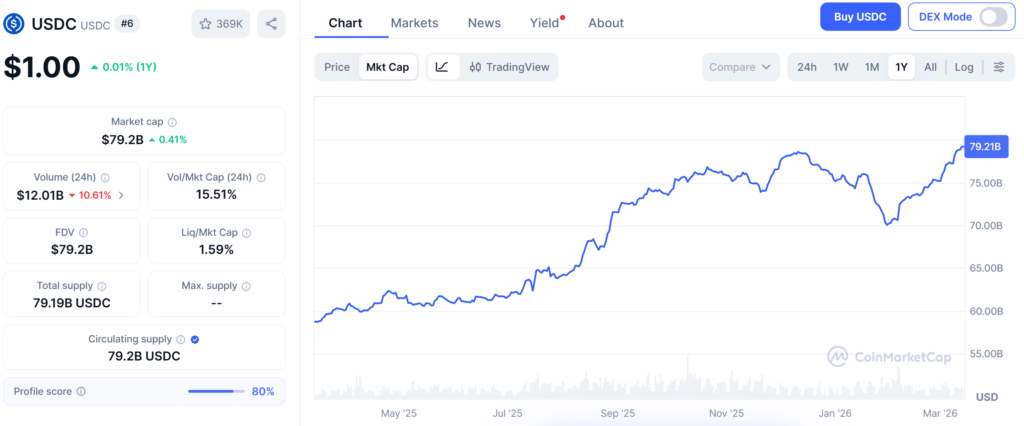
Market analysts say the rapid increase reflects growing demand for digital dollar assets, particularly in regions experiencing economic or market turbulence.
Dubai Based Analyst Points to Capital Flight
A Dubai based market analyst, Rami Al-Hashimi, suggested that the surge in USDC demand may be tied to investors moving funds out of conventional markets.
In a post on X (formerly Twitter), Al Hashimi said over the counter trading desks in Dubai have struggled to keep up with requests for the stablecoin. According to him, investors appear to be seeking faster and more flexible ways to move capital.
He described the situation as a period of financial stress where uncertainty is pushing investors toward digital assets. Stablecoins like USDC are often used as a bridge between traditional currencies and cryptocurrencies, allowing investors to move funds quickly without exposure to the volatility of other crypto assets.
Real Estate Slump Raises Concerns
The analyst also connected the spike in stablecoin demand to turmoil in Dubai’s property sector. According to his claims, property prices in the city have dropped by roughly 27 percent this month, triggering concerns among investors and property owners.
Market data from TradingView supports the broader trend of weakness in the sector. The DFM Real Estate Index, which tracks listed real estate and construction companies in Dubai, has experienced a steep decline.
The index reportedly fell from around 16,800 at its recent high to about 11,516, representing a drop of roughly 31 percent. Such a sharp sell off has intensified fears that the property market may be entering a period of correction.
According to Al Hashimi, some investors are choosing to shift capital into digital assets during this period rather than keeping funds tied to real estate.
Property Sellers Begin Accepting Crypto Payments
Another notable development is the growing willingness of some property sellers to accept cryptocurrency payments. Al Hashimi claimed that certain real estate listings are now offering discounts to buyers who pay with crypto.
He said that some sellers are offering price reductions between five and ten percent for buyers willing to settle transactions in Bitcoin.
While such offers are still limited, they highlight the increasing role of digital assets in cross border transactions and alternative investment strategies. In markets where liquidity concerns or uncertainty exist, cryptocurrencies and stablecoins can provide faster settlement and easier international transfers.
USDC Surpasses USDT in Transaction Activity
While USDC remains the second largest stablecoin by market capitalization, recent research suggests it has gained ground in transaction activity.
According to a research note from Mizuho Financial Group, USDC has overtaken Tether (USDT) in adjusted transaction volume for the first time since 2019.
The report estimates that USDC recorded around $2.2 trillion in adjusted transaction volume so far this year. In comparison, USDT processed roughly $1.3 trillion over the same period.
This gives USDC approximately 64 percent of the combined transaction share between the two stablecoins, indicating that it is increasingly being used for payments, transfers, and trading activity.
Tether Still Dominates Stablecoin Market
Despite the shift in transaction volume, USDT remains the largest stablecoin by market capitalization. According to available data, Tether currently holds a market cap of about $184 billion.
In comparison, USDC’s market cap of around $79 billion places it firmly in second position but still far behind its main competitor.
However, the recent growth in supply and transaction activity suggests that USDC continues to gain traction among institutional users, traders, and investors looking for stable digital dollar alternatives.
As global markets experience periods of volatility, stablecoins are increasingly playing a central role in capital movement and digital finance. The latest surge in USDC supply highlights how quickly investor behavior can shift when traditional markets show signs of stress.