
























































































Bitcoin fell sharply over the weekend, dropping close to $63,000 after the United States and Israel confirmed a military operation targeting Iran’s nuclear infrastructure. With traditional financial markets closed, the crypto market reacted in isolation, amplifying volatility and triggering widespread liquidations.
At the time of writing, Bitcoin was trading near $64,000, down nearly 4 percent on the day, as traders responded to escalating geopolitical tensions in the Middle East.
Trump Confirms Joint Operation With Israel
In a video address, US President Donald Trump confirmed that American and Israeli forces had carried out coordinated strikes inside Iran. He stated that the operation was aimed at disabling key elements of Iran’s nuclear infrastructure.
Trump also delivered a direct message to the Iranian public, urging them to take control of their government once the operation concludes.
“When we are finished, take over your government; it will be yours to take,” he said. “This will be, probably, your only chance for generations. For many years, you have asked for America’s help, but you never got it.”
The remarks added to already heightened tensions and fueled uncertainty across global markets.
Crypto Markets React Alone as Traditional Markets Stay Shut
Because the strikes occurred over the weekend, stock exchanges and most traditional financial markets were closed. That left crypto markets as the only major asset class actively trading, forcing digital assets to price in the geopolitical shock without input from equities or futures markets.
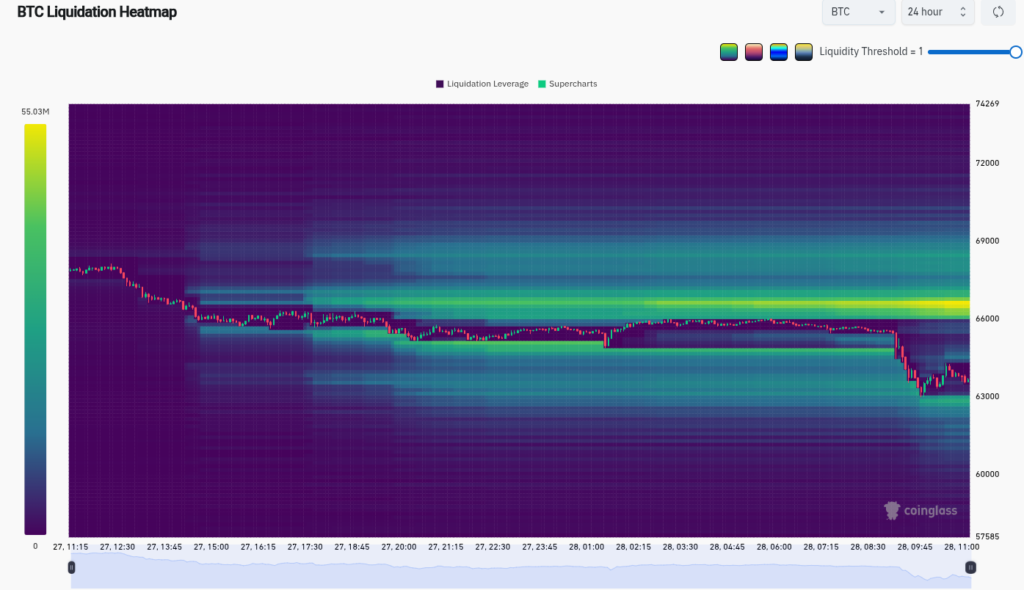
Data from TradingView showed Bitcoin testing the $63,000 level shortly after the announcement. Meanwhile, liquidation data from CoinGlass indicated that more than $250 million in leveraged positions were wiped out within four hours, highlighting the speed and intensity of the selloff.
Trading resource The Kobeissi Letter noted on X that this marks the second time in eight months that the US and Israel appear to be engaged in direct conflict with Iran. A previous offensive in 2025 triggered sharp and volatile moves across crypto and other risk assets, offering a recent precedent for the current reaction.
Key Support Levels Still in Focus
Despite the drop, Bitcoin has so far managed to hold core support levels, keeping traders focused on whether the $63,000 region can withstand further selling pressure. The timing is critical, with the February monthly close approaching.
Bitcoin is already on track for its fifth consecutive monthly loss, a streak not seen in seven years. The current drawdown mirrors the scale of losses recorded in February 2025, underscoring the strain on bullish sentiment.
Market participants are watching closely to see whether additional headlines from the Middle East, or developments in US policy, could push prices lower before traditional markets reopen.
Inflation Pressures Add to Headwinds
Geopolitics is not the only factor weighing on Bitcoin. Hot US inflation data released on Friday had already dampened bullish momentum. Earlier in the week, traders attempted to reclaim support levels closer to $70,000 but failed to sustain a breakout.
The combination of persistent inflation concerns and fresh geopolitical risk has created a challenging environment for risk assets. If stock index futures open lower when trading resumes, further volatility could spill into the crypto market.
For now, Bitcoin remains in a fragile position. The $63,000 level stands as an immediate line of defense, while traders brace for how global markets will respond once the full financial system comes back online.