




















































































Ethereum price has faced resistance near the $3,400 mark, but market data continues to point toward a constructive outlook as long as key support levels remain intact. Ether has declined about 7 percent from last week’s highs and is now trading close to critical demand zones. Still, rising staking activity, improving institutional participation and a well defined technical support range suggest that ETH could stage a sustained recovery in the coming weeks.
Below are the three main factors supporting Ethereum’s bullish structure above $3,000.
Staking demand hits multi year highs
Ethereum staking activity has surged to levels not seen in over two years, highlighting growing confidence among long term holders. According to ValidatorQueue data, more than 2.6 million ETH, valued at roughly $8.3 billion at current prices, is waiting to be staked. The entry queue now stretches to around 44 days, the longest since mid 2023.
The Ethereum network currently has about 978,657 active validators, with close to 29.8 percent of the total ETH supply locked in staking. This translates to roughly 36.1 million ETH removed from liquid circulation. Analysts have described the spike in staking interest as a strong signal of accumulation rather than distribution.
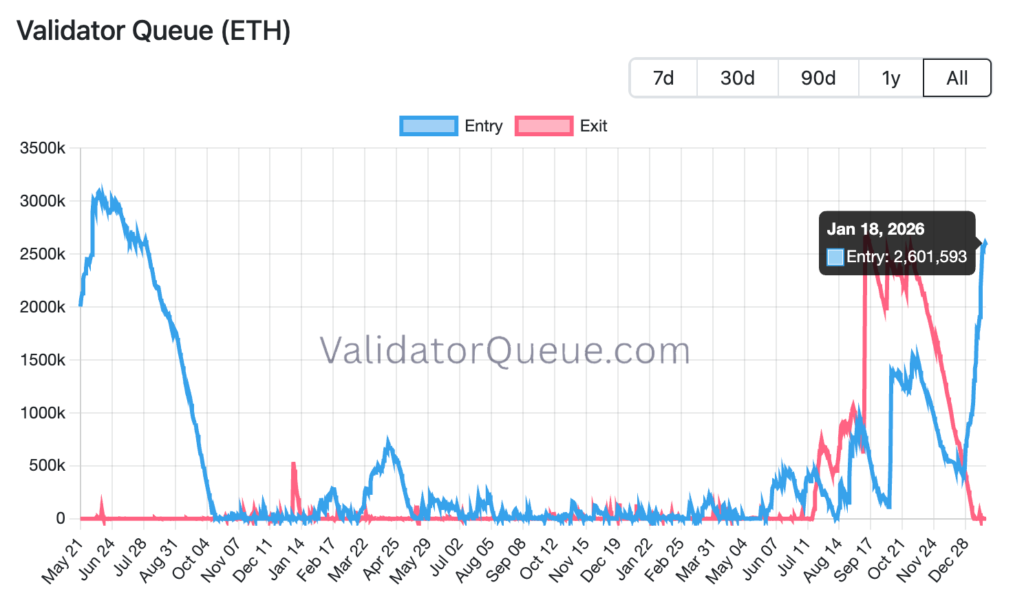
At the same time, the validator exit queue has dropped to zero. This indicates that fewer participants are leaving the network or selling their staked ETH, reducing near term sell pressure. Market observers often view a cleared exit queue as a sign that investors prefer to earn yield through staking instead of exiting positions.
Onchain analysts have pointed out that a similar setup occurred in mid 2025, shortly before Ether posted a sharp rally toward its previous record highs. While past performance does not guarantee a repeat, the current supply dynamics favor a tighter market structure.
Institutional accumulation and ETF inflows return
Another key pillar supporting ETH above $3,000 is renewed demand from institutional players. Data from Capriole Investments shows that strategic ETH reserves and exchange traded funds have increased their combined holdings by around 10 percent since late November 2025. These entities now control more than 12.2 million ETH, representing nearly 9.7 percent of the total supply.
This steady accumulation suggests that large investors are using price pullbacks to build exposure. Many of these entities also stake their ETH to generate yield, further contributing to the growing staking queue and reducing liquid supply on exchanges.
Corporate treasuries continue to play a notable role. BitMine Immersion Technologies, chaired by Tom Lee, remains the largest corporate holder of Ether. The company recently staked an additional 186,560 ETH, worth approximately $625 million, bringing its total staked balance to more than 1.53 million ETH. That figure accounts for about 4 percent of all ETH currently staked on the Beacon Chain.
Spot Ethereum ETFs are also showing signs of recovery. According to SoSoValue, ETH ETFs recorded inflows on every trading day last week, totaling $479 million. This followed a brief outflow period earlier in January, when funds shed around $351 million over three days. The return of consistent inflows suggests improving sentiment among traditional investors.
Strong cost basis support near $3,100
Onchain cost basis data highlights why the $3,100 to $3,170 range is so important for Ethereum’s price structure. Roughly 3.27 million ETH was accumulated within this zone, creating a dense cluster of holders with an average entry price in that area.
This concentration often acts as a support level, as investors who bought there are more likely to defend their positions during pullbacks. As long as ETH trades above this range, downside pressure remains limited.
Technical analysts also point to the 21 day simple moving average, which aligns closely with the $3,170 level. Holding above this moving average is seen as critical for maintaining short term bullish momentum. Several market participants have noted that ETH has respected this level during recent corrections, reinforcing its role as a key pivot.
If buyers continue to defend the $3,050 to $3,170 demand zone, Ethereum could regain upward momentum and attempt another move toward the $4,000 region. A sustained break below this area, however, would weaken the bullish case and open the door to deeper retracements.
Supply tightening supports medium term outlook
Beyond immediate price levels, Ethereum’s broader supply dynamics remain supportive. Rising staking participation, declining exit activity and growing institutional ownership all contribute to reduced circulating supply. With a significant portion of ETH locked for yield, fewer tokens are readily available to meet new demand.
This setup creates favorable conditions if buying pressure continues through ETFs, corporate treasuries and long term holders. While short term volatility is likely, the underlying trend points toward accumulation rather than distribution.
As long as Ethereum holds above the $3,000 psychological level and maintains support near $3,100, market data suggests the path of least resistance remains to the upside.