






















































































A newly disclosed bug in Bitcoin Core versions 30.0 and 30.1 has raised serious concerns among users running older wallet setups, after developers confirmed that the flaw can delete wallet files and potentially lead to permanent loss of funds. The issue, which surfaced earlier this week, has prompted the Bitcoin Core team to pull the affected binaries from its official download page and accelerate work on a patched release.
The bug is limited in scope but severe in impact, especially for users with legacy wallets and non standard configurations. While it does not affect Bitcoin’s consensus rules or network security, it highlights ongoing risks at the wallet software layer, particularly in an ecosystem where one implementation dominates node usage.
What the Wallet Migration Bug Does
Bitcoin Core developers explained that the problem lies in the wallet migration process introduced to help users upgrade older wallets to newer formats. Under specific conditions, the migration logic mistakenly deletes the entire wallet directory after appearing to complete successfully.

The risk arises when an old, unnamed legacy wallet file called wallet.dat is stored inside a custom wallet directory, often defined using the -walletdir option, and pruning is enabled on the node. During migration, the software attempts to move and clean up files but incorrectly identifies the directory structure. As a result, it removes all wallet files stored locally.
If a user does not have an external backup, access to funds is effectively lost. Once the local wallet files are gone, there is no way to recover private keys unless copies exist elsewhere.
Who Is Most at Risk
According to Lacie Zhang, a market analyst at Bitget Wallet, the bug mainly affects users running very old Bitcoin Core wallets that were never renamed or previously upgraded. These setups are more common among long time node operators who customized their directory layouts years ago and continued running the same configuration.
The risk is highest when several factors line up. These include running Bitcoin Core version 30.0 or 30.1, using a legacy wallet, storing wallet.dat in a custom or mounted wallet directory, and having pruning enabled. If a migration has already been triggered or is pending, the chance of data loss increases sharply.
By contrast, users relying on hardware wallets, newer wallet formats, or modern third party wallet software are unlikely to be affected. Shawn Odonaghue, community lead at layer 3 blockchain Orbs, said the issue mostly impacts outdated setups and should not concern the average user who upgraded wallets years ago.
Developers Pull Releases and Prepare Fix
Bitcoin Core 30.1 was released on January 1, and the migration bug was publicly disclosed on Monday. Soon after, developers removed both version 30.0 and 30.1 binaries from the official website to prevent further exposure.
The project advised users not to use wallet migration tools until a fixed release, Bitcoin Core 30.2, becomes available. Importantly, developers noted that users who are already running these versions but are not attempting any wallet migration can continue operating their nodes normally.
Zhang said technically experienced users can assess their exposure by checking their Bitcoin Core version, confirming whether their wallet is a legacy one, and reviewing the debug.log file to see if pruning is enabled or if any migration attempts have occurred. Inspecting the directory layout to verify where -walletdir points is also critical.
For users who have not yet attempted a migration, the advice is clear. Back up the entire data directory to external storage immediately and avoid restarting or upgrading until moving directly to version 30.2 or later.
Bitcoin Core’s Dominance Raises Broader Questions
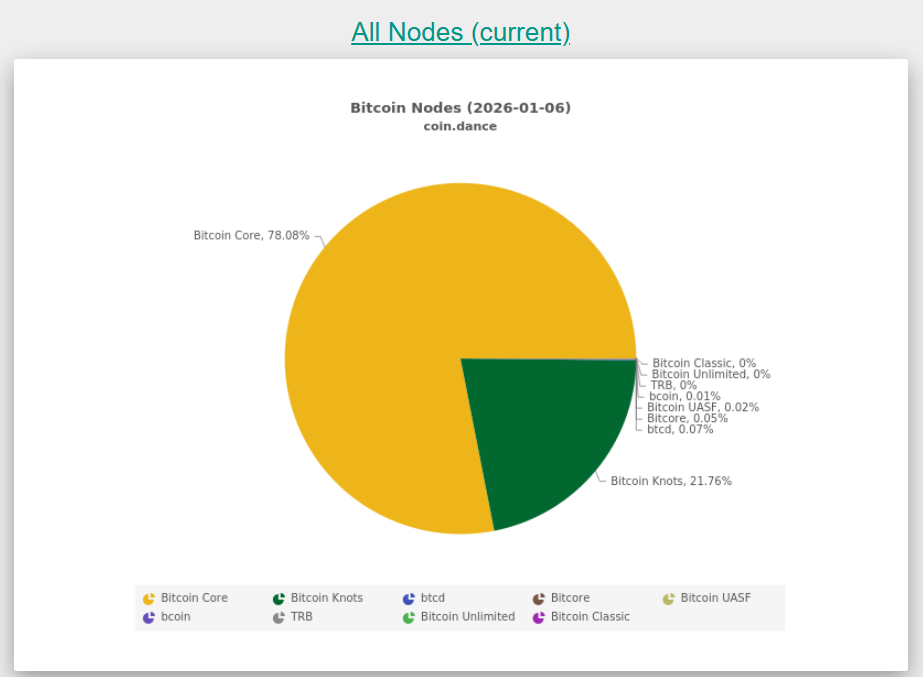
While the bug is not consensus critical, its discovery has reignited discussion around concentration risk within the Bitcoin ecosystem. According to data from Coin Dance, Bitcoin Core currently powers around 78 percent of reachable Bitcoin nodes. Other implementations, such as Bitcoin Knots, account for most of the remainder.
That level of dominance means that even edge case bugs can have an outsized impact. A flaw affecting a small subset of users can still translate into meaningful losses when one software client is so widely used.
Odonaghue said the incident underscores the risks of relying too heavily on a single implementation. When one client becomes the default choice, any design mistake or overlooked edge case can ripple through the ecosystem, even if the underlying protocol remains secure.
Zhang added that while the bug does not threaten Bitcoin’s consensus or chain integrity, it shows how wallet layer issues can scale quickly. User funds ultimately depend on local key management, and failures at that level can be just as damaging as more visible network attacks.
A Reminder on Backups and Caution
The Bitcoin Core wallet bug serves as a reminder of the importance of regular backups and cautious upgrades, especially for users running long lived nodes. Software improvements often introduce new logic that may not fully account for legacy setups still in use.
As developers finalize Bitcoin Core 30.2, users are being urged to pause any wallet migration activity, review their configurations carefully, and ensure backups exist before making changes. For those affected, prevention remains the only protection, since once wallet files are deleted without backups, recovery is not possible.