




















































































The world’s largest stablecoin issuer, Tether, is once again at the centre of speculation after reports emerged that it is exploring a massive fundraising round at a valuation of around $500 billion. Adding fuel to the chatter, BitMEX co-founder Arthur Hayes suggested that such a move could reshape the competitive landscape of stablecoins and potentially put rival Circle under pressure.
Hayes Points to IPO Rivalry
Hayes, a long-time industry commentator, reignited debate about a possible Tether IPO. His comments followed reports that the company is in talks with investors to raise as much as $20 billion. According to Hayes, if Tether went public after Circle’s successful listing earlier this year, the implications could be severe for Circle.
“Next up a US IPO. Bye bye Circle,” Hayes wrote, alluding to the competitive gulf between the two stablecoin issuers.
Circle’s recent IPO was oversubscribed more than 25 times and helped lift its valuation to around $33 billion. But compared to Tether’s rumoured $500 billion figure, the gap is stark. With USDT’s market cap at $173 billion, more than double USDC’s $73.6 billion, Hayes implied that Circle’s reliance on Coinbase for distribution leaves it at a structural disadvantage.
A $500 Billion Pitch
Bloomberg reported that Tether is considering raising between $15 billion and $20 billion in a private placement that would value the company at half a trillion dollars. Cantor Fitzgerald is said to be acting as lead adviser, with discussions still at an early stage.
Such a valuation would place Tether in the same league as household names like SpaceX, Coca-Cola, Costco and OpenAI. In June, analysts had already floated a similar number, estimating Tether’s worth at $515 billion, which would make it the 19th most valuable company worldwide.

According to CEO Paolo Ardoino, any funds raised would be used to strengthen the firm’s diverse business lines and expand its global footprint. However, questions linger over whether Tether genuinely needs fresh capital given its immense profitability.
Profits, Scale and Distribution
Tether’s financial performance is one of the key reasons behind the eye-watering valuation. The company reported $4.9 billion in profit in Q2 2025 alone, with $3.1 billion generated from recurring yield-based income. On an annualised basis, excluding mark-to-market gains, this implies a price-to-earnings ratio of about 40x for the proposed valuation.
By comparison, Circle has been far less profitable, weighed down by its revenue-sharing deal with Coinbase. Unlike Tether, which distributes USDT widely across global markets, Circle depends heavily on Coinbase to move USDC at scale, which significantly reduces its margins.
Hayes highlighted this disparity, noting that investors must consider not just issuance but also how stablecoin products are distributed.
IPO or Opportunistic Raise?
Despite the fundraising reports, Tether’s leadership has previously downplayed the prospect of going public. In June, Ardoino said the company had “no intention” of pursuing an IPO, signalling confidence in its current private structure.

Bloomberg also cited Bo Hines, CEO of Tether USAT, a newly created US-focused entity, as saying the firm has no plans to raise additional funds. This adds to the uncertainty, with some suggesting the chatter could represent opportunistic positioning while yields remain high.
Macro investor Raoul Pal raised doubts about the long-term case, questioning what happens “if yields fall back to 2%.” Community voices also suggested that if Tether did pursue an IPO, it might consider spinning off a US-regulated subsidiary while keeping its global business private.
Dominance in a Growing Market
Regardless of the fundraising rumours, Tether continues to dominate the stablecoin sector. Its $172.8 billion market cap accounts for roughly 56% of the $307 billion global stablecoin market, according to CoinMarketCap.
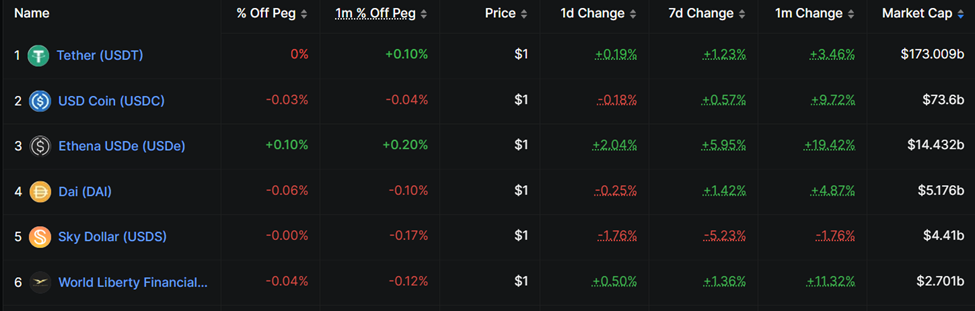
Adoption of stablecoins is accelerating worldwide, driven by demand for low-cost transfers, enhanced financial access and blockchain-based settlement rails. In the United States, the recently passed GENIUS stablecoin bill is expected to bolster the role of dollar-backed tokens by providing regulatory clarity.
Circle’s public debut underscores this trend, but Tether remains far ahead in profitability and scale. Its ability to generate billions in profit per quarter with a lean workforce has made it one of the most profitable companies globally on a per-employee basis.
Outlook
Whether Tether actually pursues an IPO remains uncertain. The firm is immensely profitable and does not appear in urgent need of capital. However, a half-trillion-dollar valuation would place it firmly among the world’s corporate giants, reinforcing its dominance not just in crypto but in global finance.
For now, the speculation and Hayes’ provocative comments highlight the intense rivalry between Tether and Circle. With regulation tightening and adoption soaring, the battle for stablecoin supremacy is only set to intensify.