











































































BitGo, a US-regulated cryptocurrency custodian, has partnered with asset manager Fonte Capital to safeguard assets for Central Asia’s first spot Bitcoin exchange-traded fund (ETF), launched on the Astana International Exchange (AIX) in Kazakhstan.
Historic Listing on the Astana International Exchange
The Fonte Bitcoin Exchange Traded Fund (BETF) made its debut on Wednesday under the framework of the Astana International Financial Centre (AIFC). Managed by AIFC-registered Fonte Capital, the fund offers indirect Bitcoin investment to a broad range of investors, including retail participants.
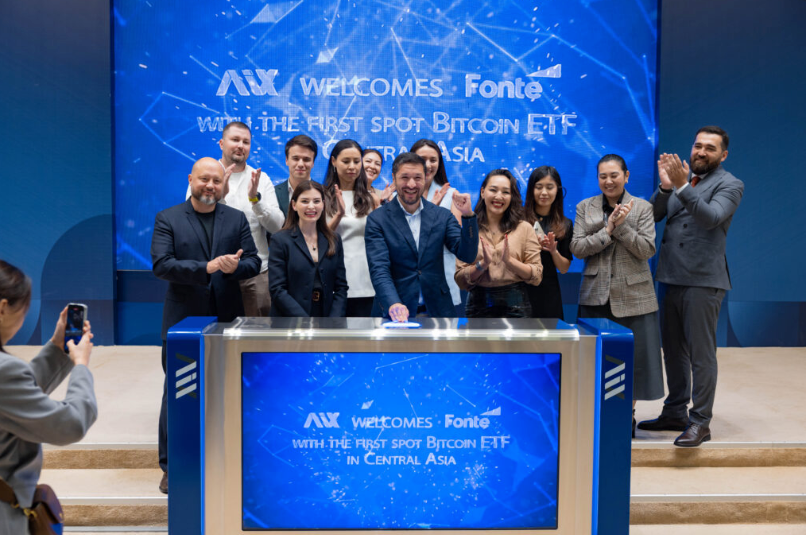
Physically backed by Bitcoin held in BitGo Trust’s custody, the BETF provides investors in Kazakhstan with institutional-grade Bitcoin exposure for the first time. BitGo Trust, a subsidiary of BitGo, is known for providing custody services to major US Bitcoin ETF issuers such as ARK Invest and 21Shares.
Secure US-Regulated Custody for Kazakhstan
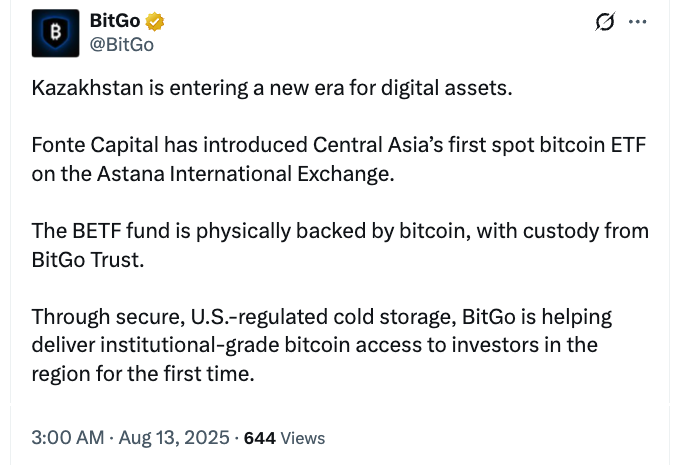
BitGo described Kazakhstan’s ETF launch as marking “a new era for digital assets” in the country. It will provide its custody services through US-regulated cold storage, ensuring secure institutional-grade asset protection.
While BitGo confirmed its involvement, neither Fonte Capital nor AIX mentioned the custodian in their public statements. The parties were contacted for comment but had not responded at the time of publication.
Benefits and Risks of Relying on Global Custodians
Industry experts say the use of a global custodian like BitGo is both an advantage and a limitation. According to Shady El Damaty, digital identity innovator and co-founder of human.tech by Holonym, such arrangements inspire investor confidence but also highlight the concentration of infrastructure in a few global players.
“On one hand, you’re getting institutional-grade custody right out of the gate. On the other, it shows how concentrated this infrastructure still is,” El Damaty said. He added that countries should work toward developing local custodians that meet global security standards to enhance financial sovereignty and resilience.
Bakhrom Saydulloev, product lead at crypto payments firm Mercuryo, agreed, stressing that local custody is vital for long-term sovereignty. However, he acknowledged that using an established global custodian is currently the fastest route to building credibility and attracting foreign investment.
Boost for Kazakhstan’s Crypto Market
The launch of BETF is seen as a milestone for Kazakhstan’s growing cryptocurrency sector. El Damaty noted that while relying on a single global custodian is not ideal for the long term, it enables developing markets to bring crypto products to investors more quickly.
“BitGo’s involvement gives Kazakhstan an instant credibility boost,” he said.
AIX, founded in 2017 and backed by the AIFC, the Shanghai Stock Exchange, the Silk Road Fund, and Nasdaq, reported around $130 million in monthly trades as of July 2025. Though its trading volumes are small compared to exchanges like Nasdaq, which recorded $73 billion in European equity trades last month, the BETF offers a regulated entry point to Bitcoin for local investors who have previously lacked access.
Kazakhstan’s Role in the Global Digital Asset Landscape
Saydulloev highlighted Kazakhstan’s emergence as a significant player in the global crypto industry, particularly in cryptocurrency mining. He described tools such as spot Bitcoin ETFs as a bridge for investors and the wider public to participate in the digital economy.
“In regions where traditional finance has left huge gaps, tools like this can connect everyday people to new economic opportunities,” El Damaty added.
The BETF’s introduction reflects a broader trend of expanding regulated cryptocurrency investment options into new markets, with Kazakhstan positioning itself as a gateway for Central Asia.