




















































































While earlier research has warned that artificial intelligence might introduce security risks in software development, smart contract developers and auditors now believe AI-assisted coding is actually improving the safety of crypto ecosystems.
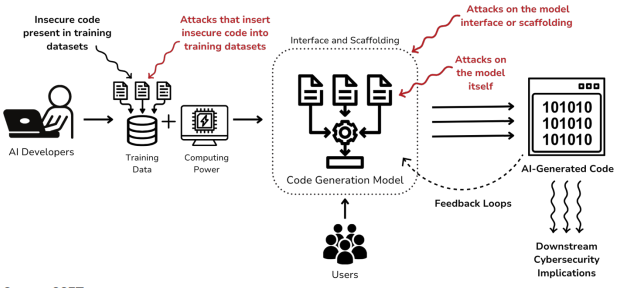
A November 2024 report by the Center for Security and Emerging Technology (CSET) raised alarms over the security of AI-generated code, highlighting that nearly half of the snippets produced by leading models contained bugs. Another July 2024 study found that top AI models had a secure-code pass rate below 35%, based on a 180-task benchmark across 44 known vulnerability types.
However, blockchain developers working on real-world projects disagree with the broader pessimism. They argue that, when used responsibly as an assistant tool, AI significantly enhances code quality and saves time, especially for experienced developers.
AI Enhances, But Doesn’t Replace Developers
The prevailing view among smart contract engineers is that AI is most useful as a supplement, not a replacement.
0xAw, the pseudonymous lead developer at Base-based decentralised exchange Alien Base, explained that he uses AI primarily for “quick reference checks” and to generate basic or “cookie-cutter” code. He has recently become more open to letting AI perform “quick sanity checks” but only for simple, obvious issues.
Similarly, Anton Holovchenko, a senior blockchain developer at security firm Hacken, uses Cursor, an AI-powered development environment, for features like code autocompletion and smart templating. However, he warns against letting AI take over without developer intervention. “The programmer must still adjust the code, correct errors, and ensure context relevance,” he said.
Holovchenko also dismisses the idea of “vibe coding” the practice of letting AI write large chunks of code with minimal oversight. “That’s risky. AI should aid, not dominate,” he asserted.
Widespread Use Among Crypto Programmers
Despite the concerns in academic circles, AI tools are already widely used in smart contract development.
0xAw remarked that “everyone” he knows in the industry uses AI “to some extent,” though mainly as an assistant. While junior developers often over-rely on these tools, senior engineers appreciate the productivity gains they offer.
Mike Tiutin, CTO of crypto forensics firm AMLBot, said that the adoption of AI in development is “quite high.” Holovchenko added that nearly every developer he knows uses some AI tools, with ChatGPT and Cursor being the most popular.
Even so, all agree that the quality of output depends heavily on the skill of the user. Without a solid understanding of programming fundamentals, overreliance on AI can result in poorly written or insecure code.
AI May Boost Web3 Security with the Right Human Oversight
There is a growing belief among developers that AI can enhance Web3 security by enabling faster identification of flaws and reducing careless mistakes.
Holovchenko believes that AI-assisted development will lead to higher-quality code, but only when paired with human expertise. “If you’re just vibe coding or relying too much on AI, you’ll believe your code is safe without truly knowing it. That’s dangerous,” he said.
0xAw pointed out that smart contract development typically involves extensive testing, meaning bugs generated by AI are likely to be discovered and fixed before deployment. Still, he voiced concern that junior developers might struggle to grow into senior roles if they become overly dependent on AI.
Tiutin, on the other hand, sees long-term benefits. He expects AI to improve baseline security across protocols by reducing human oversight errors. This, he believes, will also allow smart contract auditing firms to optimise internal costs, without necessarily lowering the audit price as what clients pay for is the reputation and accountability of the auditor, not just the code review itself.
“Audits are more about sharing responsibility than actual contract security,” Tiutin noted.
AI Is a Tool, Not a Shortcut
Despite warnings from academic research, the crypto industry’s hands-on developers are largely optimistic about AI’s role in smart contract development. When used correctly, AI is seen as a powerful assistant that can boost productivity, code accuracy, and even Web3 security.
Still, developers agree on one thing: AI is not a substitute for skill. The future of secure, scalable smart contract development lies in combining human judgment with intelligent tools, not replacing one with the other.