






















































































Blockchain investigator ZachXBT has made serious accusations against Garden Finance, a popular Bitcoin bridging protocol that boasts lightning-fast, cross-chain swaps. In a post on June 21, ZachXBT alleged that the platform, despite branding itself as decentralised and secure, was actually facilitating the laundering of stolen crypto funds, particularly from the Bybit exchange hack.
The accusations highlight growing concerns in the crypto space over so-called decentralised platforms acting as covers for illegal activities.
Over 80% of Fee Revenue Tied to Stolen Funds
ZachXBT claims that more than 80% of Garden Finance’s fees were earned through suspicious transactions linked to the North Korean Lazarus Group, a cybercrime outfit known for its role in several high-profile crypto thefts. This includes funds allegedly stolen during the Bybit hack.
The claim was made in response to a post by Jaz Gulati, Garden Finance’s co-founder, who celebrated the project’s success, stating it had collected 38.86 BTC in fees around $300,000 in just 12 days ending June 2.
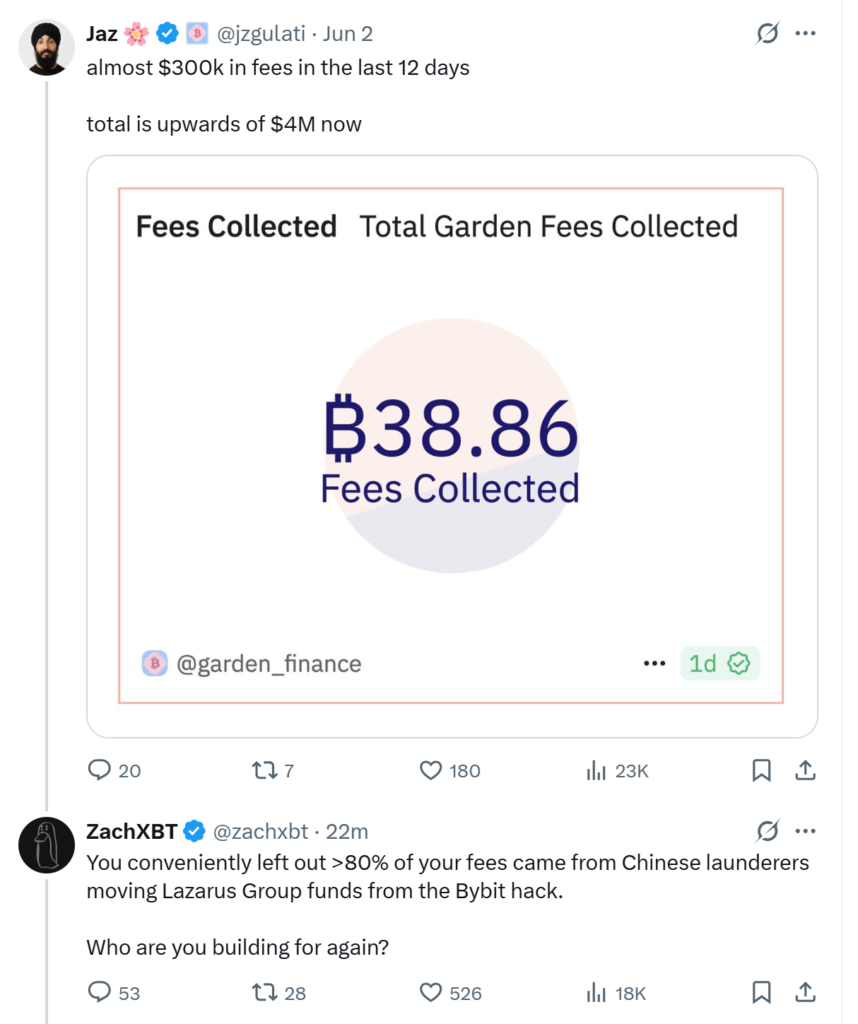
ZachXBT quickly replied:
“You conveniently left out >80% of your fees came from Chinese launderers moving Lazarus Group funds from the Bybit hack.”
This sparked widespread discussion about the platform’s operations, transparency, and its claimed decentralised nature.
Decentralised in Name Only?
ZachXBT didn’t stop at fee accusations. He also challenged the “trustless and decentralised” nature of Garden Finance’s model. According to him, a single actor repeatedly topped up cbBTC liquidity from Coinbase, essentially controlling the flow of funds through the bridge.
“Explain how it is ‘decentralised’ when I watched in real time for multiple days as a single entity kept topping up cbBTC liquidity from Coinbase,” he posted.
Such a pattern, he argues, undermines the decentralised narrative pushed by Garden, and raises questions about how much control the team or selected actors have over the protocol’s operations.
Garden Finance Responds, But Questions Remain
In response to the growing criticism, co-founder Jaz Gulati denied the laundering allegations and called ZachXBT’s claims misinformation. He noted that 30 BTC in fees were collected before the Bybit incident, suggesting not all fee revenue is linked to illicit activity.
He also rejected the “fake decentralised” label, though he did not address the Coinbase liquidity issue directly.
Garden Finance positions itself as a zero-custody bridge, claiming to enable atomic swaps of BTC across chains within 30 seconds. According to its own analytics dashboard, the platform has processed more than 24,984 BTC, worth over $1.5 billion, across 40,571 swaps. In total, it has collected over 40 BTC in fees, with its biggest single transaction involving 10 BTC.
However, with these serious allegations now public, the project’s credibility and future are under pressure.
Larger Concerns Around Crypto Laundering
The allegations come just days after another major crypto crime made headlines. Iurii Gugnin, founder of Evita Pay, was arrested in New York and faces 22 federal charges related to a $530 million money laundering scheme.

According to the U.S. Department of Justice, Gugnin used crypto to help clients including those tied to sanctioned Russian banks like Sberbank and VTB bypass restrictions and access sensitive U.S. technologies. If convicted, he could face life in prison.
The crackdown on Gugnin, combined with ZachXBT’s revelations about Garden Finance, underscores a broader concern: crypto platforms even ones claiming to be decentralised are increasingly being used for global money laundering schemes.
As regulators and investigators ramp up scrutiny of the crypto space, platforms like Garden Finance may soon be forced to prove their decentralisation and tighten KYC/AML compliance. While Garden Finance denies all wrongdoing, the community and authorities will be watching closely.